
Jean-Victor Schnetz, 1826
A Philosopher in Chains
Once a man of high rank and great wisdom, Boethius now sits behind cold iron bars. Once trusted by kings, now a prisoner awaiting his fate. The Roman philosopher, known for his writings on justice and virtue, was accused of treason and locked away—not for crime, but for speaking the truth.
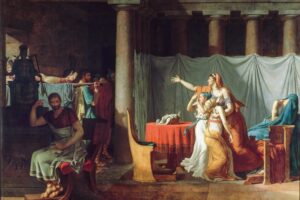
In this tender painting, we do not see the grandeur of court or the weight of books. We see a man as a father, as a husband, as a human being—saying goodbye.
A Family’s Final Visit
The scene unfolds at the entrance of a prison cell, where the light of love warms even the darkest stone.
- Boethius, gray-haired and solemn, leans forward through the iron bars. His eyes are heavy, his hands reaching for the child before him—not with strength, but with aching gentleness. This is a goodbye that no father wants to make.
- His wife, dressed in red and gold, lifts their child high into his arms. Her back is to us, but we feel her strength—steady, silent, and full of sorrow. She holds up the little boy so Boethius can kiss him one last time.
- The child, barefoot and innocent, stretches toward his father. He does not fully know what goodbye means, but his small arms reach for love he can feel. His golden curls glow with the light of youth, a painful contrast to the grief around him.
The Silent Witnesses
In the corner, an older woman, possibly a servant or relative, kneels on the floor. Her hands are clasped, eyes lifted in a quiet prayer or perhaps a plea. She cannot change what’s coming, but she watches with the full weight of heartbreak.
Beside her, a dog looks up, still and watchful. Dogs, often symbols of loyalty, remind us here of bonds that last even when words fail.
Behind the bars, guards in armor stand silently. They are part of the world that has condemned Boethius—but they too seem hushed in the presence of this final farewell.
More Than a Farewell
This moment is not just about parting—it’s about what remains. Even in chains, Boethius still offers love. Even with sorrow, his family brings him comfort. The prison bars divide them, but their spirits stay connected.
Schnetz’s brush tells a story of dignity in suffering, of courage in loss, and of how love continues even when fate turns cruel.
A Legacy Beyond Stone
Boethius would go on to write The Consolation of Philosophy in that prison—a book that shaped Western thought for centuries. But this painting shows something just as powerful: the wisdom of the heart.
It reminds us that even the greatest minds are also fathers, sons, husbands. That even in history’s darkest corners, tenderness can shine through.
About Artist
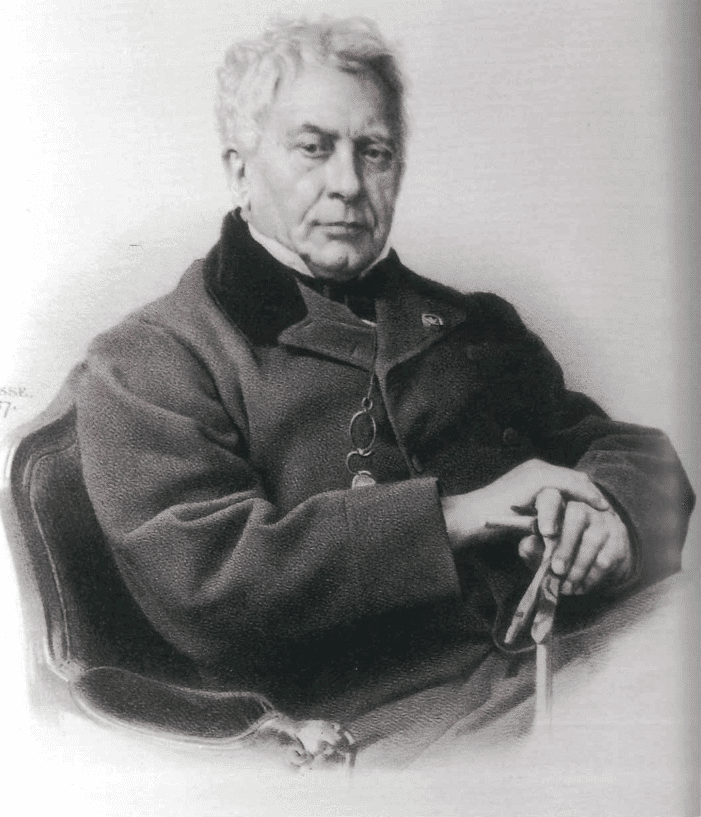
Jean-Victor Schnetz was born on April 14, 1787, in Versailles, France, and died March 15 (or 16), 1870 in Paris. He studied under prominent French painters including Jacques-Louis David, Jean-Baptiste Regnault, Antoine-Jean Gros, and François Gérard. Schnetz was an accomplished academic painter mainly known for his historical and genre scenes. He first exhibited his work at the Salon in 1808 and continued until 1867, earning the gold medal for history painting in 1819.
Schnetz was twice appointed director of the French Academy in Rome (1841–1846 and 1853–1866), where he encouraged painting from nature rather than from plaster models alone. He was elected to the Académie des Beaux-Arts in 1837 and was honored as a Chevalier of the Legion of Honor in 1825, rising to Commander in 1866.
Artistic Style
Schnetz’s style bridges Neoclassicism and Romanticism. His works often feature historical, religious, and genre subjects with a strong narrative quality. He combined the dramatic color palette favored by Romantics—dominated by reds and yellows—with the compositional clarity and coolness characteristic of Neoclassical training under David. This made his paintings dynamic but controlled, balancing emotion and order.
Notable Artworks
- Boethius Bidding Farewell to his Family: This painting depicts the Roman philosopher Boethius saying goodbye to his family before his execution. It is housed at the Musée des Augustins in Toulouse, France. The work is a poignant historical scene that reflects Schnetz’s interest in dramatic and moralizing subjects.
- Fight in Front of the City Hall on 28 July 1830: Painted in 1833, this historical scene captures the second day of the July Revolution in Paris. The composition focuses on a youthful hero dying on the barricades amid a mixed crowd united in struggle for liberty. It is held at the Petit Palais in Paris and showcases Schnetz’s romanticized yet measured approach to contemporary history.
- Procession of Crusaders around Jerusalem, 14 July 1099 (1841): An epic historical painting that illustrates crusaders around Jerusalem on the eve of its capture. The work is very large and displayed at the Château de Versailles. It reveals Schnetz’s interest in medieval and religious history enriched with strong compositional order and vivid coloration.
Additional noted works include genre scenes such as The Assassinated Woman, illustrating dramatic narratives with emotional focus typical of Schnetz’s oeuvre.
Great Artist
Jean-Victor Schnetz remains significant as a Neoclassical artist who successfully integrated Romantic drama into academic history painting, leaving a legacy of well-crafted, narrative-rich works exhibited in major European collections. His leadership of the French Academy in Rome influenced generations of French artists towards naturalism in their studies.