
Table of Contents
Overview
Laughter bursts across the table in The Joker by Gaetano Bellei, one of the 19th century’s most beloved storytellers of ordinary life. An old man, mid-jest, leans toward his companion, his arm raised in animated delight. The elderly woman beside him hides her face in laughter, half-shy, half-overcome with joy.
Painted around the late 19th century, The Joker is a celebration of humor and companionship—a timeless moment of two souls sharing laughter after a simple meal. Bellei’s genius lies not in grandeur, but in finding greatness within the familiar: a kitchen, a jug of wine, and the joy of being alive together.
With warmth, wit, and tender realism, Bellei captures the universal language of laughter—spontaneous, honest, and profoundly human.
The Joker: Laughter That Never Ages
Gaetano Bellei, 1857–1922 – Genre Painting and the Joys of Ordinary Life
Painted during the late 19th to early 20th century, The Joker by Italian artist Gaetano Bellei captures a warm, familiar kind of mischief. Bellei was part of a tradition of genre painters who focused not on myth or heroism, but on the lives of ordinary people—celebrating their humor, habits, and humanity. In this work, painted with remarkable realism and charm, we witness not a formal portrait or a grand narrative, but a moment of laughter between two elderly souls.
The Scene Before Us
An older man and woman sit at a table, remnants of a simple meal between them. The man gestures widely, his face lit up with delight, as if caught mid-punchline. Across from him, the woman hides her laughter behind her arm, flushed and delighted. Her headscarf and patterned blouse contrast with his rough jacket and red scarf. A half-empty bottle and two glasses of red wine hint at a shared story told over drink. There is no stage here, no spotlight—just the honest joy of two people who have known each other a long time.
The Deeper Meaning
At first glance, this may seem like mere comedy. But behind the humor is tenderness: a lifetime of shared meals, inside jokes, and resilient affection. Bellei’s technical skill allows each wrinkle, each fold of fabric, to feel alive and textured. Yet the true artistry lies in capturing an emotion that is fleeting—the precise moment of joy, untouched by pretense. These are not actors. They are us. Aging bodies, but youthful hearts. The painting reminds us that laughter does not retire with age; it grows deeper, richer, more precious.
A Moment Caught in Time
What makes this moment so vivid is its familiarity. We’ve seen this at family dinners, in village cafés, in our grandparents’ kitchens. It’s a universal scene—one that needs no translation. The white tablecloth, stained and crumpled, makes no attempt at elegance. The dishes have been used. The wine has been poured. What remains is connection. Bellei’s gift lies in making the ordinary beautiful, the everyday eternal. In this shared burst of laughter, the years vanish. They are not old. They are simply alive.
Artist
Gaetano Bellei (1857–1922) was an Italian painter born in Modena, trained at the Accademia Atestina di Belle Arti under Adeodato Malatesta. His early works were influenced by academic realism, but his mature style embraced the emotional storytelling of Italian genre painting.
Bellei followed in the footsteps of Gaetano Chierici, Giovanni Battista Torriglia, and Eugenio Zampighi—artists who painted domestic life with sincerity and warmth. His subjects were peasants, children, and elders, often portrayed with humor and affection rather than idealization.
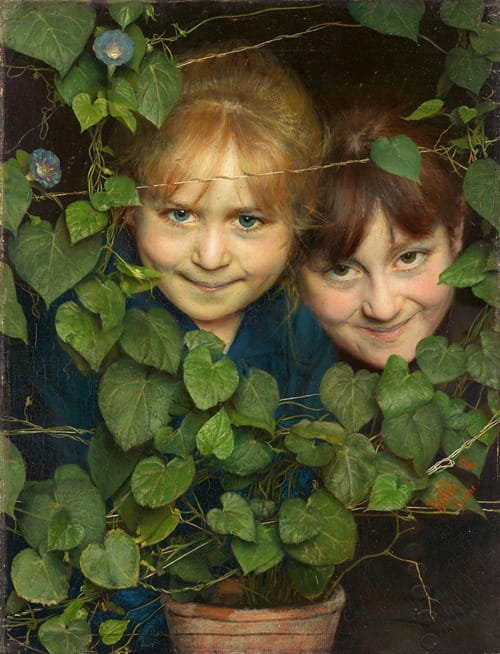
Over time, Bellei became known for the authenticity of his scenes and the humanity of his figures. His works like The Cherries, One More for the Road, and The Joker are not just pictures of people—but portraits of laughter, tenderness, and shared experience.
Gaetano Bellei
The Paintings Story
The scene unfolds in a modest interior—a simple table covered with a white cloth, a few dishes, two glasses of red wine, and a wicker-covered flask. The meal has ended, but the conversation has not.
The man, animated and gleeful, throws his arm wide in mid-story, his weathered face alive with mischief. Across from him, an elderly woman bends in laughter, her arms crossed as if to hide her delight. Her headscarf slips slightly, her smile glowing beneath the wrinkles of age.
Everything about the setting feels authentic: the crumbs on the table, the modest crockery, the dim brown wall behind them. Yet the painting radiates light—from their laughter, from Bellei’s affection for his subjects, and from the humanity of the moment itself.
It is not a portrait of jest alone—it is a tribute to joy that survives life’s hardships.
Artistic Context
During the late 19th century, Italy experienced a flourishing of genre realism—scenes of rural or working-class life painted with truth and sentiment. After centuries of religious and mythological art, painters turned toward the people around them: their humor, work, and domestic warmth.
In this context, Bellei’s art bridged craftsmanship and compassion. Like his contemporary Eugenio Zampighi, he used realism not for social critique but for celebration—the dignity of ordinary life, the beauty of laughter, the poetry of companionship.
The Joker exemplifies this shift: art that does not lecture, but simply reminds us of what it means to be human.
Composition and Subject Matters
Bellei’s composition is intimate and balanced. The figures fill the frame, drawing the viewer into the shared laughter. The table forms a stable horizontal line anchoring the scene, while the man’s sweeping gesture creates diagonal movement and energy.
The woman’s pose—curved inward, modest, smiling—contrasts perfectly with his outward expressiveness. This balance of energy and restraint makes the moment believable and engaging.
The placement of the empty dishes and half-filled glasses reinforces the after-dinner setting—ordinary details elevated into storytelling. Through composition alone, Bellei captures the rhythm of conversation and the spark of life.
Style and Technique
Bellei paints with a realist’s precision and a storyteller’s warmth. His color palette is earthy and natural: deep browns, warm reds, muted whites. The textures of skin, fabric, and wood are rendered with tangible accuracy.
Light enters subtly from the left, illuminating the faces and hands—the emotional core of the scene—while the background remains soft and unobtrusive. The folds of the woman’s dress, the sheen of the jug, the shine of the wine—all show Bellei’s technical control.
Yet beyond technique lies the true artistry: movement, expression, and humanity that feel utterly alive.
Symbolism and Meaning
The symbolism in The Joker is simple yet profound.
- The shared table symbolizes unity and companionship.
- Wine, a recurring motif in Bellei’s works, represents warmth, tradition, and conviviality.
- Laughter itself becomes the ultimate subject—a force that transcends poverty, age, and circumstance.
Bellei’s “joker” is not a fool, but a philosopher of joy—a man who finds delight in life’s smallest pleasures. His humor bridges isolation, turning an ordinary evening into an act of celebration.
The Joker: Reflection
Laughter echoes where gold has never gleamed.
A table, a flask, two hearts—enough to live on.
He gestures wide as if embracing the world,
and she hides her smile, too full to contain.
In their joy, Bellei finds eternity in the everyday.
More About Artist
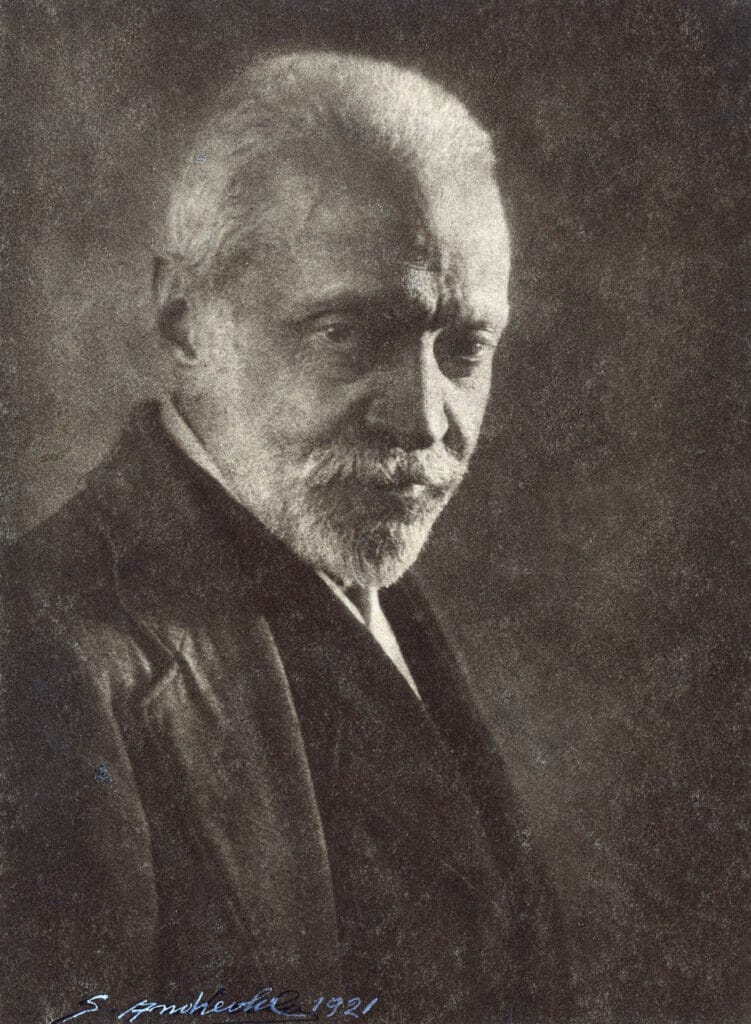
Gaetano Bellei (born January 22, 1857, Modena, Italy – died March 20, 1922, Modena) was an Italian painter best known for his genre scenes, portraits, and religious works. He completed his artistic training at the Academy of Fine Arts in Modena under Adeodato Malatesta and further honed his skills at Rome’s Accademia di San Luca, the French Academy, and the Spanish Academy. Bellei exhibited widely in Italian cities like Turin, Milan, and Rome, as well as internationally in London at the Royal Academy in 1882. He taught at the Academy of Modena from 1893 until his late years.
Artist Style and Movement
Bellei worked primarily within the genre painting tradition, focusing on everyday scenes of rural life and intimate family moments, often featuring elderly people and children. His style blends excellent technical skill with a narrative sensibility that captures human emotions and interactions vividly and tenderly. Though rooted in academic tradition, some of his works showed influence from realism and symbolist tendencies, and he experimented occasionally with Art Nouveau and divisionism techniques. His paintings balance naturalistic detail with a warm, sometimes sentimental portrayal of Italian peasant life.
Artwork Profile / Notable Works
- The Cherries: A classic genre scene depicting a simple, joyful moment centered around sharing or enjoying cherries, embodying Bellei’s gift for capturing warm human interactions.
- The Happy Kitten (“Il micino fortunato”): Exhibited in 1885, this painting brought Bellei commercial success by illustrating a playful, heartwarming scene with a kitten that he reproduced in several variations.
- Resfa: A symbolist-inspired work with darker tones that initially caused controversy but later earned recognition as a significant contribution to modern art in Modena.
- The Port of Livorno: Demonstrates Bellei’s engagement with pointillist and divisionist brush techniques, capturing lively scenes with vibrant details.
- Religious paintings such as the altarpiece of the Redeemer for the parish of Zocca and the Blessed Cottolengo for the Rangoni chapel in Bomporto show his versatility beyond genre painting.
Gaetano Bellei remains an important figure in late 19th and early 20th-century Italian art, renowned for his ability to depict intimate scenes of human emotion with refined technical skill. His genre paintings continue to be appreciated for their narrative warmth and realism, providing a window into everyday Italian rural life and the emotional bonds within families.