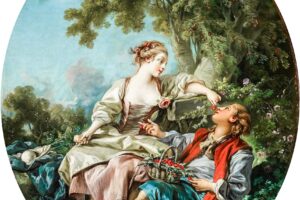

The Lady’s Hour; Getting Ready
Imagine stepping back in time to a beautiful, elegant bedroom, where a lady is preparing for her day. That’s the intimate and charming scene captured in François Boucher’s painting, “La Toilette,” created around 1742. “La Toilette” literally means “the act of getting ready” or “grooming” in French. Boucher, a master of the Rococo art style, was famous for showing us scenes that were graceful, a little bit playful, and always full of beautiful details.
Unlike his outdoor pastoral scenes, this painting brings us inside a fancy private room, giving us a glimpse into the daily life of a lady of that era.
The Morning Ritual Unfolds
At the center of the painting, we see two women engaged in the morning ritual of dressing:
- The Lady of the House: Seated comfortably on a chair, almost looking directly at us, is a lovely young woman. She is in the process of putting on her stockings, a common sight in this kind of “toilette” painting. Her expression is calm and relaxed, perhaps even a little pensive. Her hair is elegantly styled, and she wears a delicate cap and a loose white chemise over a blue skirt. Her bare arm and leg are painted with a soft, lifelike glow.
- The Attentive Maid: Standing to the right, with her back mostly to us, is a maid who is helping the lady get ready. She holds up a piece of fine lace or a delicate garment, possibly a handkerchief or a piece of trim, perhaps for the lady to choose or to admire. Her posture is one of respectful service, focusing on her task.
A Room Full of Rich Details
Boucher fills the room with exquisite details that tell us about the wealth and style of the time:
- A Cozy Fireplace: On the left, a grand fireplace is the focal point, with a small fire burning, suggesting a cool morning. On the mantelpiece, you can see candles in elegant holders, a teapot or coffee pot, and other precious items, indicating a comfortable and luxurious life. A piece of fabric draped nearby suggests warmth and comfort.
- A Loyal Feline Friend: Near the lady’s feet, a little ginger cat is curled up, sound asleep or simply resting. This adds a charming, domestic touch to the scene, making it feel more personal and warm.
- Elegant Furniture and Decor: The room is richly decorated. A beautiful wooden screen with painted birds and flowers on a gold background acts as a backdrop, possibly to provide privacy or to shield from drafts. Through the open screen, we can see another room with a painting on the wall, and above it, a smaller portrait of a woman looking down, perhaps an ancestor or another family member.
- Everyday Objects: On the floor, near the fireplace, you can spot a small sewing basket, a foot warmer, and a discarded slipper, all telling us about the routines of the room. On the right, a chair draped with a vibrant red fur-trimmed coat and a table with a powder box further emphasize the act of dressing and grooming.
A Glimpse into Private Life
“La Toilette” is more than just a picture of a lady getting dressed. It’s an intimate glimpse into the private world of an aristocratic woman in 18th-century France. Boucher captures the elegance, comfort, and sometimes even the quiet boredom, of daily rituals. It celebrates the beauty of ordinary moments, transformed by art into something graceful and charming. It invites us to imagine the sounds and smells of the room, and to appreciate the artistry involved in even the most mundane parts of life in that era.
About Artist

François Boucher (1703–1770) was a French painter, a dominant figure of the Rococo art movement. He was the most celebrated artist of his time, serving as the official court painter to King Louis XV and working closely with the king’s chief mistress and art patron, Madame de Pompadour. His style is the very essence of Rococo: playful, sensuous, and highly decorative, focusing on mythological, allegorical, and pastoral scenes.
Artistic Style and Legacy
Boucher’s style is characterized by its lighthearted and charming nature, a direct contrast to the more somber and dramatic tones of the Baroque. His paintings are known for:
- Sinuous Lines and Curves: He preferred soft, flowing lines over the rigid geometry of earlier art.
- Pastel Color Palette: He used a delicate range of light blues, pinks, yellows, and greens.
- Playful Subject Matter: He often depicted scenes of love, mythology, and idyllic country life, often with a hint of eroticism.
Boucher’s artistic influence was immense. He was a master of many mediums, including tapestry design, and his work perfectly captured the refined tastes and luxurious lifestyle of the French aristocracy before the Revolution.
Notable Artwork
- La Toilette (c. 1742): A prime example of his intimate genre scenes, it depicts a woman at her dressing table, a subject that was popular in Rococo art.
- The Mysterious Basket (c. 1748): This is a work with a playful, ambiguous title, characteristic of his whimsical style.
- The Fountain of Love (c. 1748): A mythological and allegorical scene celebrating love, a classic Rococo subject.
- The Bird Catchers (c. 1748): Part of a series of idyllic pastoral scenes, this work exemplifies his charming depictions of country life.
- Spring (1755) from a series titled “The Four Seasons”: This work was created as part of a decorative set for Madame de Pompadour.
- Pastoral Scene (c. 1735): Boucher painted many similar scenes of shepherds and shepherdesses in idyllic settings, a cornerstone of his work.
- Madame de Pompadour (1756): One of his most famous portraits. It shows his patron in an opulent, relaxed setting, surrounded by objects that reflect her intellect and status.
- Les Sabots (c. 1768): Also known as “The Clogs,” this is another pastoral scene, showing a country girl in an idealized setting.
- A Lady on Her Day Bed (1743): This intimate portrait shows a woman in a relaxed, private moment, a popular theme in Rococo art that celebrated luxury and leisure.