
Table of Contents
Overview
A gentle morning unfolds in Farmyard Scene by Jan David Col, where sunlight touches cobblestones, hens scatter across straw, and a playful suitor teases a young woman spinning wool. The air hums with domestic peace — a rooster crows, a cat dozes in the warmth, and laughter softens the day’s routine.
Painted in the later 19th century, this lively tableau reflects Col’s love for quiet village life and his gift for turning ordinary chores into tender storytelling. Every detail — the broom, the green birdcage, the red jars by the doorway — feels touched by affection and truth.
Col invites us into a world that never rushes, where humor and work blend naturally, and the simplicity of life itself becomes art.
Farmyard Scene: Love in a Tease and Tumble
A Genre Painting of Rural Wit and Warmth, by Jan David Col, 1822–1900 –
Created in the 19th century by Belgian genre painter Jan David Col, Farmyard Scene is a cheerful glimpse into rustic domestic life, brimming with affection, mischief, and morning bustle. Col was known for painting lighthearted everyday moments, often with a playful wink. Here, amid the hum of a farmhouse, the ordinary becomes delightful, and a small joke takes center stage in the quiet theatre of rural life.
The Scene Before Us
The courtyard is alive. Chickens cluck and peck, a rooster crows near the straw, and kittens tumble across the cobbled floor. A broom lies askew, a cat peeks from an overturned box, and a red hen scuttles by. In the midst of this mild chaos, a young woman sits at her spinning wheel. Her face is warm, her smile shy, as she pretends not to notice the man tiptoeing behind her, a long feather in his hand and mischief in his eye.
The man—perhaps her suitor or husband—prepares to tickle her, balancing his gun playfully as if returning from a hunt. His expression is caught in that universal moment before a joke lands: a mix of eagerness and affection.
The Deeper Meaning
On the surface, this is a humorous moment. But look longer, and there’s more than laughter. The painting radiates the familiarity of love—not grand declarations, but the tiny games we play with those we cherish. The cluttered farmyard, the animals, the worn boots, the chores—these are not distractions from the joke; they are the stage that makes it meaningful. In Col’s eyes, humor isn’t a break from life—it is life, woven into work, into love, into the simplest gestures.
A Moment Caught in Time
This is a painting of joy in motion. The woman will burst into laughter. The man will chuckle. The hens will scatter. The kitten will chase a falling feather. And yet it all stands still for us, frozen in the calm before delight. Jan David Col invites us not just to smile at the prank but to recognize ourselves in it—the lightness we sometimes forget we need, the silliness that warms a home more than fire ever could.
Artist
Jan David Col (1822–1900) was a Dutch painter born in The Hague and trained at the Royal Academy of Fine Arts in Antwerp. He belonged to the second generation of the Dutch Romantic-Realist school, following artists like Pieter de Hooch and Gerard Dou in depicting intimate interiors and rustic exteriors with loving precision.
Col specialized in genre scenes—simple, cheerful moments from daily rural life. His works often feature courtyards, kitchens, or village gardens animated by farmers, children, and pets. He had a keen eye for narrative gestures and a soft, luminous palette that makes his paintings both realistic and idyllic.
Through his art, Col offered a gentle counterpoint to the turbulence of industrial modernity: the reassurance of home, tradition, and human connection.
The Painting Story
The scene takes place in a farm courtyard bathed in golden light. At its heart sits a young woman, dressed in a coral skirt and white apron, spinning wool on a rustic wheel. She looks over her shoulder, half-smiling, at a playful hunter standing in the doorway behind her.
The man, carrying a musket, leans forward with a mischievous grin, teasing her with a few stalks of straw or perhaps a twig — a flirtatious gesture that turns the everyday into courtship. Around them, life continues in quiet rhythm: hens peck at the ground, a rooster struts proudly, cats lounge near a broken coop, and a broom leans idly against the wall.
Nothing monumental happens, yet the painting glows with affection and humor. Col captures not drama, but life itself — gentle, cyclical, and filled with familiar joy.
Artistic Context
In the 19th century, as industrialization transformed Europe, Dutch artists found renewed inspiration in rural scenes and the domestic harmony of earlier centuries. Painters such as David Bles, Hermanus Koekkoek, and Jan David Col kept alive the legacy of 17th-century Dutch genre painting, reinterpreting it for a modern audience craving simplicity and nostalgia.
Col’s Farmyard Scene stands firmly in this tradition. It unites the precision of the old Dutch masters with the sentimental storytelling of Romantic Realism. Unlike academic historical painters, Col found meaning in the humble rhythms of village life — in light, laughter, and the warmth of ordinary moments.
Composition and Subject Matters
Col arranges the painting around a strong diagonal that leads from the man at the doorway to the seated woman and onward to the bright courtyard beyond. This compositional flow creates a sense of depth and movement.
The architecture, props, and animals are arranged in harmony: the open window with red shutters balances the straw roof and tree line, while scattered chickens animate the foreground. The woman’s calm posture contrasts with the man’s forward motion, giving the scene playful tension.
Small details — a broom on the ground, hanging jugs, sunlight dappling hay — transform realism into narrative. Col’s skill lies not only in observation, but in making each detail feel alive with character.
Style and Technique
Jan David Col painted with meticulous realism softened by warm light. His palette favors soft ochres, greens, and warm reds that create an inviting, pastoral glow. The textures — weathered brick, woven straw, feathers, and cloth — are rendered with exceptional clarity.
His brushwork is controlled but lively, especially in the play of light on surfaces: the gleam on pottery, the shimmer of feathers, the shadows cast by the spinning wheel. The balance of naturalism and charm reflects the influence of both Dutch Golden Age masters and his Romantic contemporaries.
Col’s technique turns simplicity into elegance, every stroke affirming his affection for country life.
Symbolism and Meaning
Though lighthearted, Farmyard Scene carries subtle symbolism:
- The spinning wheel represents domestic diligence and the continuity of tradition.
- The rooster and hens evoke fertility, family, and rural abundance.
- The playful hunter symbolizes courtship and the spark of love within daily life.
The setting itself — a well-kept yard alive with animals — celebrates balance between work and joy. Col’s moral is simple: happiness grows where care and kindness dwell.
Through humor and tenderness, he reminds viewers that even the smallest acts — a shared smile, a tease, a morning chore — hold meaning.
Farmyard Scene: Jan David Col
Morning hums with sunlight and laughter.
The broom rests, the hens chatter,
and the air carries both labor and love.
He teases, she smiles,
and in their glances the whole countryside breathes.
Jan David Col paints not just a scene, but a life remembered.
More About Artist
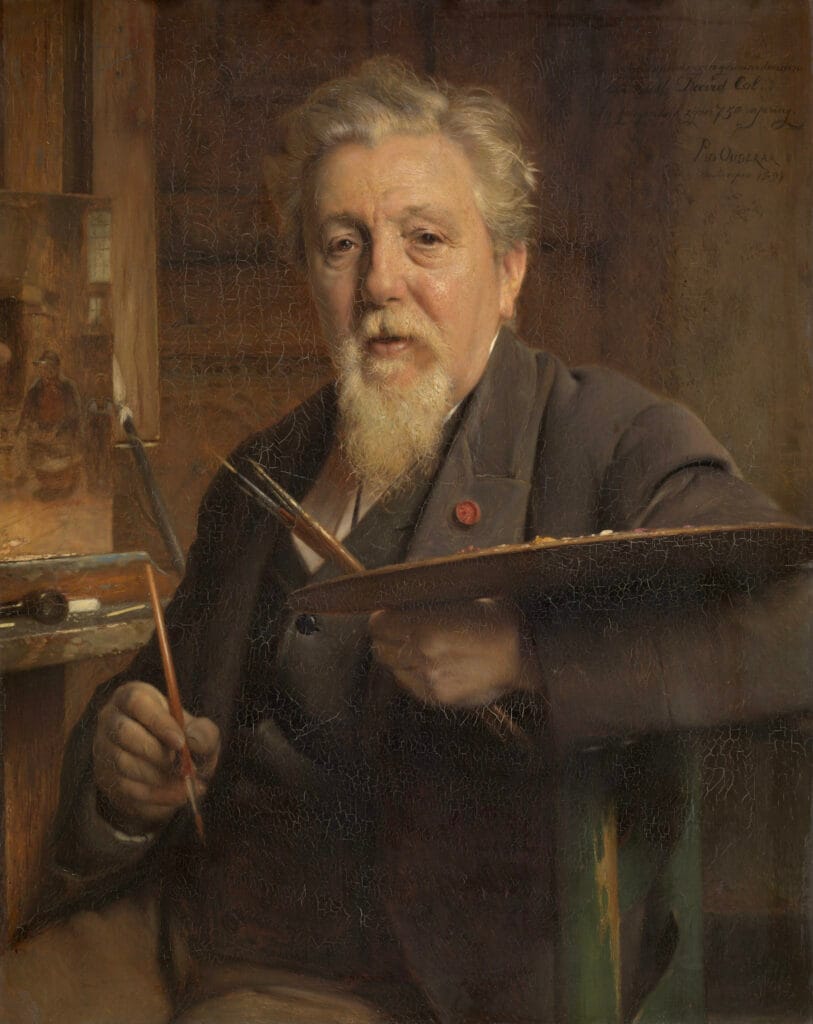
Jan David Col (April 6, 1822 – February 19, 1900) was a Belgian artist known primarily for his genre scenes. Born in Antwerp, he studied at the Royal Academy of Fine Arts in Antwerp under Nicaise De Keyser. Col gained popularity with his mildly humorous and anecdotal depictions of daily life and exhibited widely starting from 1846. His works are housed in museums such as the Royal Museum of Fine Arts Antwerp and the Groeningemuseum in Bruges.
Artist Style and Movement
Col’s style aligned with Belgian realism and genre painting traditions, highlighting everyday scenes enriched with gentle humor and keen observation. Influenced by artists such as Jean-Baptiste Madou and Ferdinand de Braekeleer, he often portrayed ordinary life with narrative charm and detail. Collaborations with fellow genre painters and animal painters contributed to a diverse repertoire of domestic and rural subjects captured with warmth.
Artwork Profile / Notable Works
- Farmyard Scene: A characteristic genre depiction that captures rustic life with candid observation and narrative subtlety, showing animals and rural figures in an engaging composition.
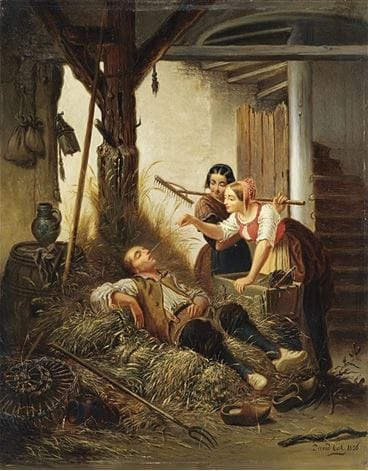
- A Sleeping Shepherd and Two Young Women: Illustrates a calm rural scene with a serene pastoral atmosphere.
- After the Hunt: Represents a moment of relaxation and camaraderie following a hunting excursion.
- The Fisherman: A genre work focused on the daily life of a fisherman, emphasizing rustic simplicity.
- A votre santé (Belgian collection): A lively scene likely involving social interaction and conviviality, typical of his mild humor and social observation.
Jan David Col’s legacy resides in his ability to combine anecdotal storytelling with precise draftsmanship and affectionate portrayal of rural and domestic life. His genre scenes, characterized by their subtle humor and warm realism, remain valued in Belgian and international art collections today, reflecting 19th-century life with charm and authenticity.