

Table of Contents
Overview
Laughter fills the summer air in The Cherries by Gaetano Bellei, a tender glimpse into the joy of ordinary life. Painted in the late 19th century, it captures an affectionate tug-of-war between generations—an old man teasingly holds a basket of ripe cherries just out of reach, while three children, bright-eyed and giggling, stretch eagerly toward it.
Bellei, known for his heartwarming scenes of family and peasant life, turns a simple act into a vivid celebration of love, warmth, and play. The painting glows with sunlight and laughter, proving that the simplest human moments can become timeless art.
In this cheerful scene, time stands still. The weathered texture of age meets the lively curiosity of youth. And beneath the humor, Bellei invites us to see the beauty in connection—the shared pulse of generations linked by affection and joy.
Cherry Season: One Basket, Two Generations
The Cherries – Gaetano Bellei, c. late 19th–early 20th century
In a sun-drenched courtyard overflowing with green, The Cherries by Italian painter Gaetano Bellei offers more than sweetness — it celebrates the timeless joy between generations. Painted in Bellei’s familiar style of affectionate realism, this heartwarming scene transforms a simple moment into a lasting memory of family, play, and love.
The Scene Before Us
At center, an elderly man — cheerful and mischievous — raises a basket of cherries above his head, just beyond the reach of three eager children. They swarm around him like laughter itself, tugging on his coat, climbing onto his knees, reaching with small, determined hands. His smile is wide and indulgent, glowing with the quiet pride of a grandfather who knows he is their entire world, if only for the moment.
The background glows with warm stone and grapevines, creating a scene soaked in sunlight and life. Bellei’s mastery lies in these very details: the folds in fabric, the twinkle in the man’s eyes, the tumble of curls, the soft blur of a distant orchard gate. Every stroke feels lovingly placed, as if the artist painted from memory.
The Deeper Meaning
This isn’t just a cherry game — it’s a celebration of the grandparent-child bond, wrapped in the light of summer. The basket, held aloft, becomes a symbol of the gifts elders pass down: joy, stories, protection, play. The children’s laughter, in turn, is their gift back.
There is no lesson here, no chore — only the rich sweetness of time shared. The elder does not correct, instruct, or restrain. He joins. He becomes the game. And in doing so, Bellei reminds us that the love between generations is not always spoken — it’s shown in gestures, in giggles, in the shared chase for a basket of cherries.
A Moment Caught in Time
The scene may be Italian, rustic, and of its time — but the feeling is universal. Anyone who has run into a grandparent’s arms, been lifted up to pick fruit from a tree, or heard an old voice say “Catch me if you can” will recognize the magic here.
This is the kind of memory that stays — not in detail, but in feeling. Bellei captures it for us: a golden afternoon, three joyful children, and one elder at the heart of it all. Time slows. Love ripens. And everything is held — briefly — in a single, laughing reach.
The Artist
Gaetano Bellei (1857–1922) was an Italian painter from Modena, celebrated for his detailed genre scenes and portraits. Trained at the Accademia Atestina di Belle Arti under Adeodato Malatesta, Bellei inherited the strong academic discipline of the Italian realist school but softened it with warmth and humanity.
Throughout his career, Bellei devoted himself to painting the lives of ordinary Italians—peasants, children, and elders in moments of humor, tenderness, or reflection. His brush carried forward the legacy of painters like Gaetano Chierici and Giovanni Battista Torriglia, emphasizing sentiment and craftsmanship over formal idealism.
Bellei’s best works—such as The Cherries, The Lesson, and Grandfather’s Story—became beloved for their theatrical energy and emotional sincerity. He merged narrative storytelling with painterly precision, giving his scenes both life and moral depth.
The Painting Story
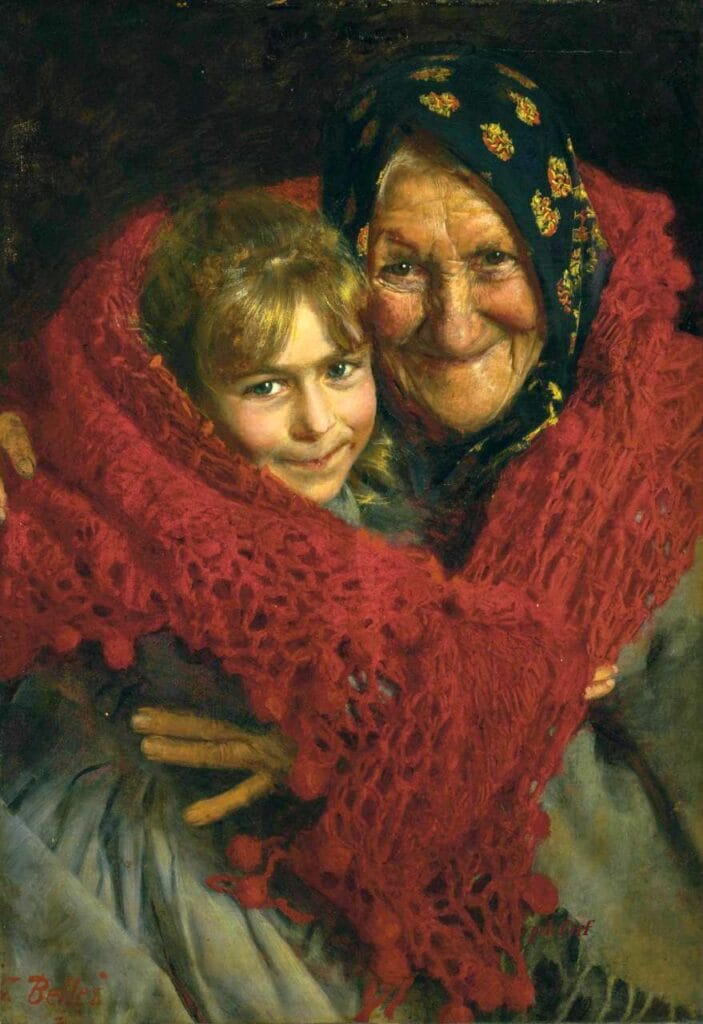
In The Cherries, an elderly man sits outdoors under a leafy vine, holding a basket brimming with red cherries high above the heads of three eager children. They climb onto his lap and tug at his arms, laughing as they try to reach the fruit. The old man’s amused expression—half-smile, half-tease—captures a playful affection rather than denial.
The wall behind them, sunlit and cracked with age, suggests a rural courtyard or garden. The children’s simple clothing, tousled hair, and bare feet speak of peasant life and summer freedom. This isn’t an idealized myth—it’s a truthful glimpse into rustic Italy, where affection, teasing, and laughter coexist naturally.
Every gesture feels alive: a little girl’s hand on her grandfather’s chin, another child’s determined reach toward the basket, the youngest clinging to his knee. The scene overflows with vitality and joy, embodying family love and the eternal rhythm of youth and age.
Artistic Context
Bellei worked during the late 19th and early 20th centuries—a period when Italian painting moved from Romanticism toward Realism and verismo. Genre painting, portraying scenes of everyday life, was cherished for its honesty and warmth.
In Northern Italy, painters like Luigi Nono, Eugenio Zampighi, and Gaetano Chierici depicted domestic simplicity and rural cheerfulness. Bellei’s The Cherries continues that tradition but heightens it with theatrical composition and vivid emotional storytelling.
Unlike earlier Rococo genre scenes that idealized peasants for charm alone, Bellei’s vision was both tender and respectful. His peasants are not caricatures but living individuals—full of spirit, humor, and human dignity.
Composition and Subject Matters
Bellei’s composition revolves around the diagonal tension between the man’s raised arm and the children’s upward reach. This playful dynamic creates movement and balance: the triangular arrangement of figures anchors the scene while leading the viewer’s eye toward the basket of cherries—the symbol of reward and affection.
The old man’s seated position and the children’s climbing gestures form a lively pyramid of action. Every detail supports the sense of interaction—the tilted stool, the woven basket, the light filtering through leaves.
Bellei’s use of gestures and gazes is masterful. The laughter and reaching hands unite the figures in a single rhythm, transforming the small courtyard into a stage for universal affection.
Style and Technique
Bellei painted with a rich, textured realism reminiscent of academic technique but softened with impressionistic light. His color palette is earthy yet radiant—warm browns, soft pinks, and bright reds of the cherries glowing under sunlight.
Brushwork alternates between fine detail (faces, folds of clothing) and loose atmospheric strokes (background vines, sky). The balance gives the painting both structure and spontaneity.
The play of light reveals Bellei’s gift for storytelling through illumination: the faces and hands, where emotion is most alive, receive the brightest attention, while the rest melts into golden shadow.
Symbolism and Meaning
The cherries, gleaming with red vitality, symbolize both temptation and sweetness—the pleasures of life that elders pass down to the young. The grandfather’s teasing act isn’t about denial but about prolonging joy, teaching patience and play in equal measure.
The contrast between age and youth suggests the cyclical nature of life. The wrinkles on the man’s face mirror the laughter lines forming on the children’s. Bellei reminds us that affection bridges generations—and that joy, like cherries in summer, ripens best when shared.
The Cherries – Gaetano Bellei
Laughter climbs like sunlight through the leaves.
An old man, time’s gentle keeper, holds joy just beyond reach—
not to withhold, but to make the moment last.
In their eyes he sees his own youth returning,
and in that simple game of cherries and laughter,
life’s circle closes with tenderness and grace.
More About Artist
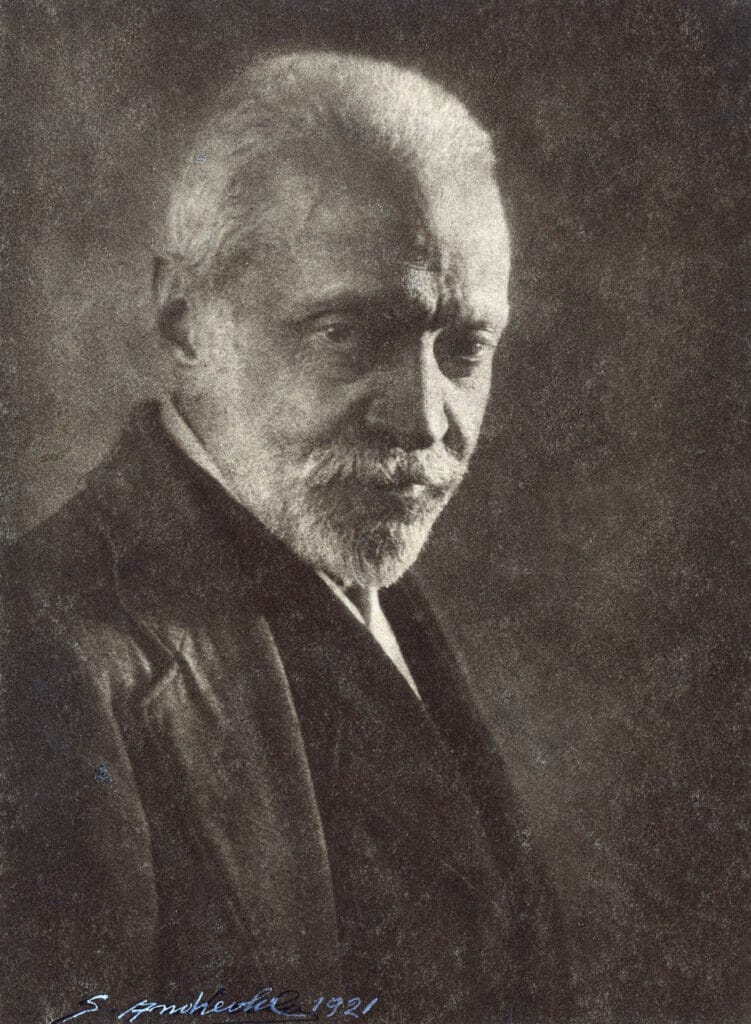
Gaetano Bellei (born January 22, 1857, Modena, Italy – died March 20, 1922, Modena) was an Italian painter best known for his genre scenes, portraits, and religious works. He completed his artistic training at the Academy of Fine Arts in Modena under Adeodato Malatesta and further honed his skills at Rome’s Accademia di San Luca, the French Academy, and the Spanish Academy. Bellei exhibited widely in Italian cities like Turin, Milan, and Rome, as well as internationally in London at the Royal Academy in 1882. He taught at the Academy of Modena from 1893 until his late years.
Artist Style and Movement
Bellei worked primarily within the genre painting tradition, focusing on everyday scenes of rural life and intimate family moments, often featuring elderly people and children. His style blends excellent technical skill with a narrative sensibility that captures human emotions and interactions vividly and tenderly. Though rooted in academic tradition, some of his works showed influence from realism and symbolist tendencies, and he experimented occasionally with Art Nouveau and divisionism techniques. His paintings balance naturalistic detail with a warm, sometimes sentimental portrayal of Italian peasant life.
Artwork Profile / Notable Works
- The Cherries: A classic genre scene depicting a simple, joyful moment centered around sharing or enjoying cherries, embodying Bellei’s gift for capturing warm human interactions.
- The Happy Kitten (“Il micino fortunato”): Exhibited in 1885, this painting brought Bellei commercial success by illustrating a playful, heartwarming scene with a kitten that he reproduced in several variations.
- Resfa: A symbolist-inspired work with darker tones that initially caused controversy but later earned recognition as a significant contribution to modern art in Modena.
- The Port of Livorno: Demonstrates Bellei’s engagement with pointillist and divisionist brush techniques, capturing lively scenes with vibrant details.
- Religious paintings such as the altarpiece of the Redeemer for the parish of Zocca and the Blessed Cottolengo for the Rangoni chapel in Bomporto show his versatility beyond genre painting.
Gaetano Bellei remains an important figure in late 19th and early 20th-century Italian art, renowned for his ability to depict intimate scenes of human emotion with refined technical skill. His genre paintings continue to be appreciated for their narrative warmth and realism, providing a window into everyday Italian rural life and the emotional bonds within families.