

Table of Contents
Overview
In At the Well (1864), Frederick Goodall paints a moment of human connection beneath the desert sun. A woman in a flowing turquoise robe stands beside a stone well, holding a jug of water. A weary traveler on a white camel leans down to receive her offering, while his animal drinks from the basin below.
Set against the arid hills of Egypt or the Holy Land, the scene glows with quiet reverence. The exchange is both literal and symbolic — water shared between strangers, kindness crossing boundaries of age and station.
Through luminous color and scrupulous detail, Goodall transforms an everyday act into a vision of grace and timeless hospitality.
At the Well – Frederick Goodall, 1864 – Genre Painting, Orientalist Style
In the golden stillness of a desert landscape, where thirst weighs heavy and silence reigns, a simple gesture carries the weight of kindness and culture. At the Well, painted in 1864 by Frederick Goodall, captures a meeting between stranger and stranger—one arriving with need, the other offering freely.
Set within the orientalist tradition of the 19th century, the painting combines documentary detail with romantic storytelling. But more than a study in dress or setting, it becomes a timeless portrait of human connection.
A barefoot woman stands beside a stone well, water jar in hand. Her turquoise-green robe shimmers in the light, adorned with red beads and silver bangles. Calm and composed, she raises a simple clay cup to a traveler high upon his camel. He leans forward, wrapped in robes of sand-colored cloth, reaching with evident thirst and humility.
His camel, adorned with tasseled harnesses, drinks deeply at the trough below. The surrounding hills ripple into the sun-bleached distance, quiet and unchanging.
Every fold of fabric, every carved strap, every shadow on the stone tells us this was a carefully studied scene—yet it feels spontaneous, like a moment that happened only once.
At the Well: Kindness Between Strangers
Though painted through a 19th-century European lens of Orientalism—where Middle Eastern life was often idealized or romanticized—Goodall’s work stands out for its respectful quietness. This is not a scene of spectacle or conquest, but of offering. It’s a picture of dignity on both sides.
The woman, though serving, does not appear submissive. Her expression is serene, even strong. The man, though seated high, reaches down not with command but with gratitude. The act of giving water—so basic, so essential—becomes here a ritual of mutual regard.
It recalls Biblical themes too: strangers at a well, journeys across deserts, hospitality shown to travelers. But Goodall doesn’t preach. He lets the image speak in gesture and gaze.
A Moment Caught in Time
What’s remarkable is the hush of it all. No noise, no movement—just the still exchange of water, and the unspoken bond between people from different worlds.
In an age of restless change, At the Well reminds us of something ancient and grounding: kindness offered in silence. Hospitality as a universal language. The shared need for water, for rest, for connection.
It is, like much of Goodall’s work, both narrative and devotional. It doesn’t shout. It doesn’t rush. It simply invites us to stop, look, and remember what it means to be cared for—and to care.
Artist
Frederick Goodall (1822–1904) was one of the most admired British painters of the Victorian era, celebrated for his biblical and Eastern subjects rendered with extraordinary realism. Born into an artistic family in London, he studied at the Royal Academy Schools and first exhibited there at age sixteen.
In the 1850s and 1860s, Goodall traveled twice to Egypt, where he lived among Bedouin tribes near Cairo and the Pyramids. These journeys profoundly influenced his art, grounding his Orientalist scenes in firsthand observation rather than fantasy.
His paintings — including At the Well, The Finding of Moses, and The Song of the Desert — captivated Victorian audiences with their harmony of realism, piety, and radiant color. Today, Goodall is remembered as one of the few artists who blended spiritual storytelling with ethnographic sincerity.
The Story
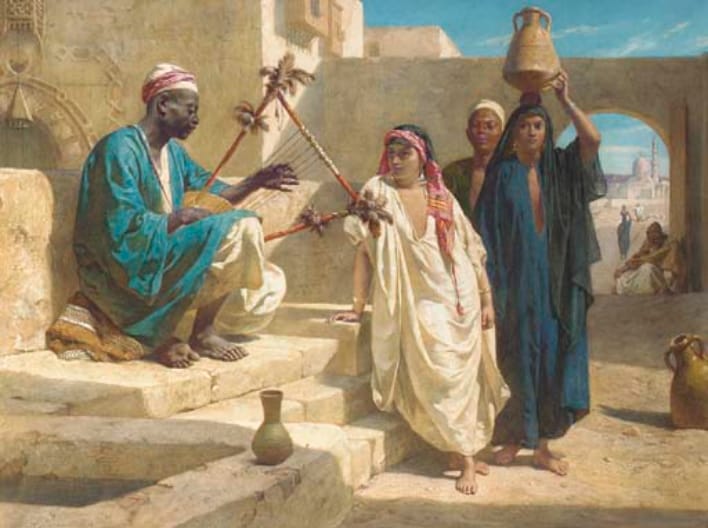
A man on a camel pauses by a desert well. His posture is weary, his robe draped loosely across his frame. The camel lowers its head to drink, adorned with tassels and patterned saddle blankets that shimmer in the sunlight.
Beside him stands a woman, poised yet modest. Her robe of deep turquoise flows in graceful folds; her left hand holds a clay jug, while her right hand extends a small bowl of water toward the traveler. Their hands meet in a gesture of quiet understanding — both practical and poetic.
The landscape is vast and silent: ochre sands, pale hills, and an open sky that seems to vibrate with heat. Yet within this stillness, a story unfolds — one of generosity, human contact, and shared survival in a harsh world.
Artistic Context
During the mid-19th century, Orientalist art flourished across Europe, inspired by travelers’ accounts of the Middle East and North Africa. While many painters romanticized these regions through fantasy, Goodall approached them with sincerity and discipline.
His time in Egypt gave him a rare authenticity. He sketched daily life — camel drivers, women at wells, shepherds, and market scenes — with attention to both physical detail and spiritual atmosphere.
In At the Well, Goodall avoids theatrical exoticism. Instead, he offers a universal moral theme — compassion in the wilderness. His restrained composition and respectful tone distinguish him from the more sensational Orientalist painters of his time, such as Gérôme or Bridgman.
The result is not spectacle, but empathy.
Composition and Subject Matters
Goodall structures the painting with geometric grace. The vertical line of the woman contrasts with the diagonal of the camel, uniting stability and movement. Their hands meet precisely at the visual center, anchoring the composition.
The textures are exquisitely balanced: coarse camel hair, smooth clay jug, woven fabric, and parched earth. Light falls gently from the left, illuminating both figures and linking them in shared glow.
The woman’s blue-green robe echoes the water’s life-giving color — a subtle symbolic touch — while the warm tones of the desert and sky emphasize the purity of her act.
Every detail, from the camel’s reins to the glint of the water bowl, speaks of precision and calm observation.
Style and Technique
Goodall’s technique is that of a meticulous realist. He paints with fine, controlled brushwork and transparent glazes, giving each texture — skin, cloth, sand — a distinct tactile presence.
His palette is luminous and harmonious, dominated by ochres, turquoise, ivory, and rose. The light feels filtered and true to the desert climate.
Goodall’s control of proportion and anatomy reflects his academic training, but his handling of atmosphere reveals an almost poetic sensitivity. The painting breathes; it feels both carefully studied and spiritually serene.
Rather than dramatize, he dignifies — inviting the viewer to witness the moral beauty of ordinary kindness.
Symbolism and Meaning
At its heart, At the Well is a painting about mercy and humanity.
- Water, the central element, symbolizes life, renewal, and divine grace.
- The woman’s act of offering embodies generosity — a moral ideal shared by all faiths and cultures.
- The camel, bending to drink, mirrors humility before nature’s gifts.
- The meeting of hands across the picture’s center signifies connection, trust, and compassion.
While some viewers see biblical resonance — recalling Rebekah and Abraham’s servant at the well — the scene also works as universal allegory: the kindness of strangers transcending landscape and creed.
At the Well: Water and Grace in the Desert
The desert gives nothing freely,
yet here, a gift is poured.
Water glows like mercy in the sun,
a thread of kindness binding lives.
In silence, they meet —
traveler and giver,
both blessed by the act itself.
More About Artist
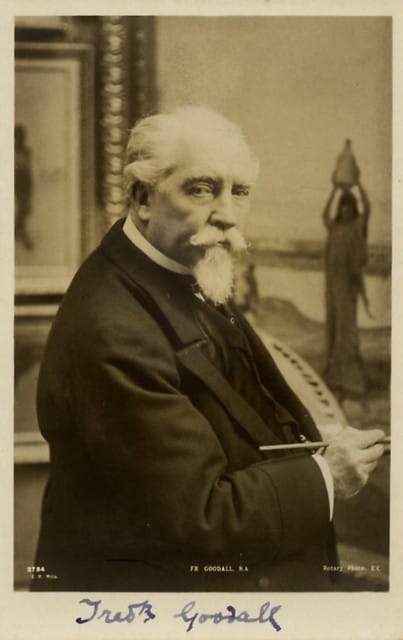
Frederick Goodall (1822–1904) was a prominent English painter renowned for his Orientalist and genre scenes. Born in London, he was trained at the Royal Academy and traveled extensively in the Middle East, particularly Egypt, which deeply influenced his subject matter. Goodall became famous for his detailed and romanticized portrayals of Oriental peoples, landscapes, and everyday life.
Artist Style and Movement
Goodall was part of the Orientalist movement in 19th-century European art, characterized by the depiction of Middle Eastern, North African, and Asian cultures through a Western lens. His style combines meticulous academic technique with vivid color and dramatic lighting to evoke the exoticism and narrative richness of his subjects. His genre paintings frequently offer intimate, poetic snapshots of daily life among diverse cultures.
Artwork Profile / Notable Works
- At the Well: This striking painting shows a desert scene where a woman offers water to a man seated atop a camel drinking from a well. The work captures a moment of quiet hospitality and everyday life with a warm palette, intricate detail on the clothing and camel’s adornments, and the stark beauty of the desert landscape.
- Other notable works include The Finding of Moses, The Snake Charmer, and The Camel Driver, all epitomizing his Orientalist focus and technical expertise.
Frederick Goodall’s legacy is marked by his evocative and beautifully executed Orientalist works that brought scenes of distant lands to Victorian England. “At the Well” exemplifies his ability to combine narrative, atmosphere, and detail to transport viewers to the evocative settings he depicted. His paintings remain cherished for their romantic vision and technical brilliance in capturing cultural and human stories. the emotional bonds within families.