

Table of Contents
Overview
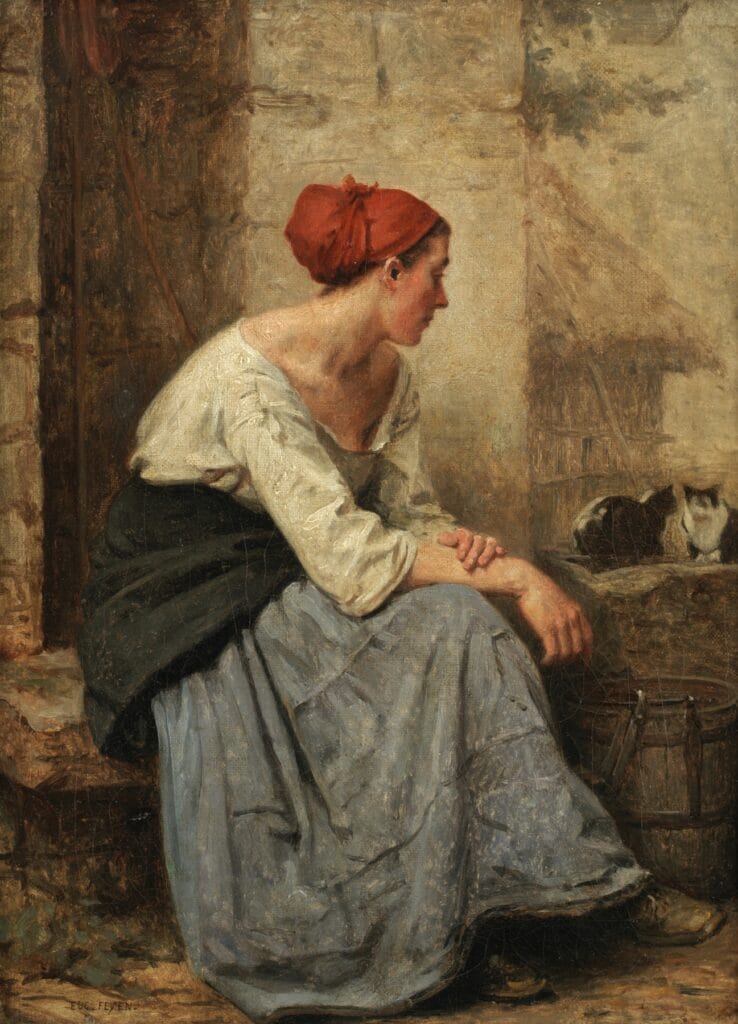
In A Domestic Incident (1870), Jacques Eugène Feyen transforms an ordinary household mishap into a masterwork of silent theater. A young maid leans against the wall, broom in hand, eyes lowered in guilt. At her feet, a shattered vase spills flowers across the polished floor. From the doorway, her mistress peers in, stern and incredulous, while a small dog looks on with nervous curiosity.
Feyen freezes the moment just before the reprimand — the instant between mistake and forgiveness. With immaculate detail and emotional subtlety, he reveals the humanity beneath a minor accident.
It’s a domestic story, yet universal: the vulnerability of those who serve, the frailty of all who make mistakes, and the quiet dignity of facing them.
A Domestic Incident – Eugène Feyen, c. late 19th century – Genre Painting
Artist
Jacques Eugène Feyen (1815–1908) was a French painter celebrated for his keen observation of daily life and refined technique. Trained at the École des Beaux-Arts under Paul Delaroche, Feyen built a career that bridged the academic and the naturalist traditions.
He painted genre scenes, portraits, and marine views, but his most enduring works — like A Domestic Incident — show his gift for emotional realism. His art blends moral warmth with compositional restraint, portraying ordinary people with respect and empathy rather than sentimentality.
Contemporaries admired his precision and gentle humor. He belonged to that mid-century generation that carried forward the spirit of Jean-Baptiste Greuze and Jean-François Millet, where moral meaning lived in everyday gestures.
A Domestic Incident: The Story
The scene unfolds in a well-kept bourgeois interior. A porcelain vase has fallen from the mantel, its pieces scattered across the floor amid spilled flowers. The young servant girl, in a white blouse and lilac skirt, stands by the wall — one slipper half off, her broom loosely in hand. Her body leans in defeat; her downcast face shows more embarrassment than fear.
At the doorway, her mistress, dressed in dark brown and white cap, appears halfway inside the room. Her expression is cautious, perhaps suspicious, as she takes in the scene. A small dog, caught in the commotion, looks up in confusion, tail raised — the perfect witness to the mishap.
Every figure is caught mid-gesture: the maid’s remorse, the mistress’s curiosity, the dog’s alertness. It’s a moment suspended — both comic and compassionate.
Artistic Context
By the 1870s, French genre painting had evolved into a refined art of observation. The public adored paintings that told moral stories — not grand histories, but slices of real life rendered with honesty and polish.
Feyen’s A Domestic Incident belongs to this tradition. Like his contemporaries Charles Baugniet, Alfred Stevens, and Jules Breton, he painted everyday people with emotional realism. His works reflect the growing 19th-century interest in domestic service and the shifting boundaries between the classes that shared the same home but not the same power.
What distinguishes Feyen is tone: he replaces judgment with understanding. The scene is humorous, yes, but also deeply human — an unspoken story about work, trust, and forgiveness.
Composition and Subject Matters
Feyen constructs the painting as a play within a room. The wall divides space between guilt and discovery: the maid’s soft diagonal posture contrasts with the upright line of the door where the mistress appears.
Light enters gently from the right, illuminating the maid’s blouse and casting the rest of the room into calm shadow. The mirror above the mantel doubles the space and deepens the perspective, creating both physical and psychological distance between the two women.
The scattered vase fragments, bright flowers, and red slippers guide the viewer’s eye downward, grounding the emotional tension in tangible detail. Feyen’s mastery of gesture and composition allows a simple accident to read like a moral parable — modest in scale, profound in feeling.
Style and Technique
Feyen’s technique reflects academic realism at its most polished. His surfaces are smooth, the brushwork invisible, yet the textures feel alive: porcelain shards, polished wood, soft fabric, even the dog’s fur.
His color palette is restrained — whites, lilacs, and umbers balanced by the warmth of red slippers and flowers. These quiet hues heighten the realism and keep emotion believable.
The lighting is key: soft, directional, naturalistic. It draws the viewer’s focus not to faces alone, but to the interplay of space — between error and consequence, humility and authority.
Through light and detail, Feyen paints truth without cruelty — his realism feels kind.
Symbolism and Meaning
- The broken vase represents both fragility and confession — beauty lost through carelessness, but also honesty in its aftermath.
- The broom suggests duty and diligence — the very tools of redemption.
- The dog embodies loyalty and empathy, reflecting the viewer’s response.
- The mirror adds moral nuance: it reflects not the act, but its emotional echo — the self’s confrontation with error.
The painting’s moral is subtle: mistakes are human, dignity is found in admitting them. In an age of strict decorum, Feyen offers forgiveness through art.
A Domestic Incident: Trouble Behind the Curtain
A crash of porcelain,
a heartbeat of silence.
Her broom hangs idle,
guilt resting heavier than shards.
Behind her, footsteps —
a glance, a question,
and in that pause,
a quiet plea for grace.
More About Artist
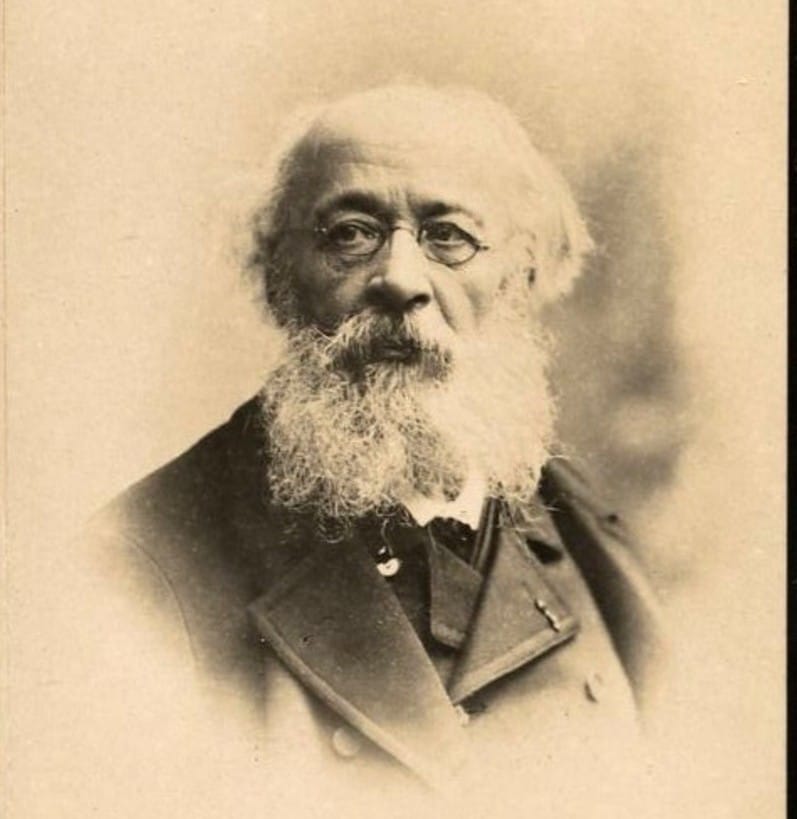
Jacques-Eugène Feyen (1815–1908) was a French genre painter and photographer known for his intimate depictions of everyday life. He studied at the École des Beaux-Arts in Paris under Paul Delaroche and exhibited regularly at the Paris Salon between 1841 and 1882. Feyen was awarded medals in 1866 and 1880 and was decorated with the Legion of Honor in 1881.
Artist Style and Movement
Feyen specialized in genre painting, focusing on scenes of domestic life and coastal village activities, especially those tied to the region of Cancale where he spent summers. His style is appreciated for its realistic and unembellished portrayal of ordinary moments, steering clear of idealization or romanticized depictions. Vincent van Gogh admired Feyen for his truthful representation of contemporary life, calling him “one of the few painters who pictures intimate modern life as it really is.” His works possess a delicate balance of narrative detail and emotional depth.
Artwork Profile / Notable Works
- A Domestic Incident: A classic genre painting capturing a subtle yet emotionally charged family scene set in a domestic interior, showcasing Feyen’s ability to convey narrative through gestures and facial expressions.
- Women and Fishermen Waiting for the Boat (circa 1860): Depicts the anticipation and community life around fishing in Cancale, illustrating Feyen’s frequent depiction of coastal life.
- Le Baiser Enfantin (The Childish Kiss) (1865): A tender, intimate scene housed at the Palais des Beaux-Arts de Lille, exemplifying his genre painting at its compassionate best.
- Views and Scenes of Cancale: Various paintings of the oyster-picking women (Cancalaises) and the bay of Mont Saint-Michel, which feature evocative regional landscapes and social interactions.
Eugène Feyen remains celebrated for his sincere portrayals of 19th-century French rural and coastal life, blending documentary observation with painterly sensitivity. His candid and affectionate depictions grant modern viewers insight into the rhythms of everyday existence in his era, securing a lasting place for him among notable French genre painters. His works continue to be exhibited and revered in museums and collections across Europe.