

Table of Contents
Overview
On a quiet Parisian street, sunlight dances across stone walls and cobblestones. A group of young women gather at a fountain, laughing among themselves. One bends forward, tilting a brass jug as water spills to the curb. Across the street, a gentleman — wig powdered and nose deep in his book — strolls obliviously toward them. The title tells us everything: A Distraction.
In this delightful tableau, Jules Girardet paints not just a scene but a smile. Every gesture, every ripple of laughter, speaks of the charm of human folly. Girardet transforms an ordinary street corner into a lively study of youth, curiosity, and fleeting amusement.
A Distraction – Jules Girardet, late 19th century
With delicate humor and theatrical flair, French painter Jules Girardet captures a fleeting moment of village mischief in A Distraction. Painted in the late 19th century, this genre scene is more than a slice of daily life—it is a charming performance, staged on the cobbled streets of a sunlit town.
Girardet, trained in the academic tradition, was known for his skill in narrative detail. Here, his paintbrush becomes a storyteller, and the town square becomes a stage where flirtation, curiosity, and a dash of boldness unfold without a word.
The Scene: The Smile Beyond the Page
A man walks with his nose deep in a book, unaware of the world around him. His black robe, powdered wig, and absorbed expression suggest a figure of scholarship—perhaps a judge, a clergyman, or a learned bureaucrat.
But the women by the fountain see an opportunity for fun.
One woman leans playfully as she tips her pitcher just enough to spill water onto the path—right in the gentleman’s stride. Another applauds the cheeky act, while two more observe with delight and curiosity. A girl peeks from behind a door, wide-eyed and eager to see what will happen next.
Everything in the painting—the glances, the grins, the pose of the woman mid-pour—suggests the moment just before the comedy erupts. We’re held in suspense, invited to imagine the splash, the startle, the laughter that will surely follow.
On the surface, A Distraction is a playful scene. But within it lies a gentle critique of pride, pretense, and the delicate power of attention.
The man is so absorbed in his book that he becomes blind to his surroundings. Meanwhile, the women, alert and alive to the moment, control the scene. Their mischief is not cruel—it’s spirited, a reminder that the world is not only to be studied but lived in.
Girardet draws a quiet contrast between knowledge and awareness, between being present and being distant, wrapped in thoughts.
A Moment Caught in Time
What makes this painting so delightful is its rhythm. Every figure, from the young girl hiding in the doorway to the tiptoeing prankster at the fountain, adds to a visual melody of motion and anticipation.
The pastel tones of the women’s dresses, the golden light, the mossy stones of the fountain—all contribute to a world that feels real and yet tinged with fantasy, like a scene from a lighthearted play.
It is a moment of everyday life elevated into art—universal, timeless, and full of charm.
Artist
Jules Girardet (1856–1938) was a French painter known for his elegant historical and genre scenes. Trained under Alexandre Cabanel at the École des Beaux-Arts, he belonged to a generation of artists who revived 18th-century grace and sentiment within the refined style of the late 19th century.
Girardet’s works — such as Departure on Honeymoon, A Visit to the Modiste, and A Distraction — combine Rococo theatricality with realist precision. His figures, though dressed in powdered wigs and silks, behave with natural warmth and humor.
In the world he painted, everyday life was a stage — but never artificial. His brush captured the sparkle of laughter and the elegance of gesture that defined the French spirit at its lightest and most humane.
The Story
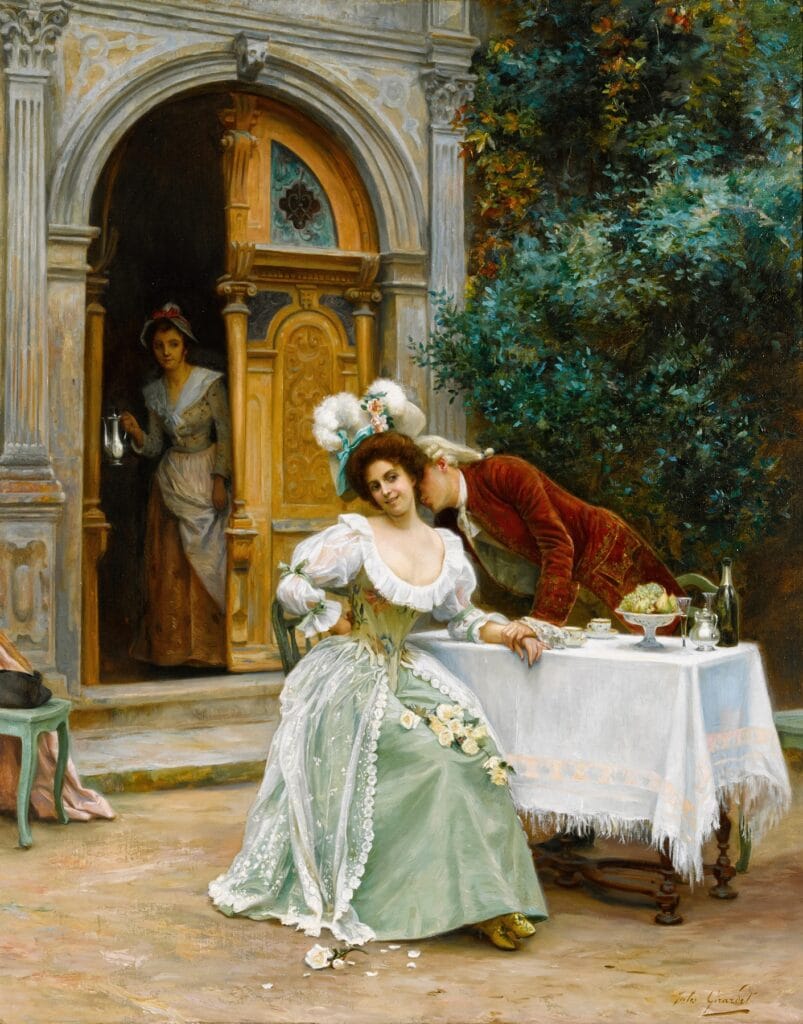
The painting unfolds like a one-act play.
At the center, three young women rest by the fountain, their conversation interrupted by the approach of a passing scholar. One of them, with mischievous grace, tips her pitcher to spill a narrow stream of water toward the street. Her friend claps in delight, while another pretends composure but cannot hide her smile.
A child by the pump watches the scene eagerly; another woman in a red skirt glances back toward the viewer, complicit in the prank.
Meanwhile, the gentleman continues reading — blissfully unaware that his polished shoes are about to meet a puddle.
Girardet captures that instant just before laughter bursts — a universal moment of lighthearted mischief suspended in time.
Artistic Context
By the late 1800s, Parisian audiences adored the Rococo Revival, a movement that revisited the playful elegance of 18th-century France. In an age of industrial progress and social change, these paintings offered a window into gentler worlds — where beauty, wit, and manners ruled the day.
Girardet stood among the most refined interpreters of this style. Unlike many of his contemporaries who veered into sentimentality, he balanced humor with humanity. His street scenes, filled with flirtation and good cheer, recall the spirit of Watteau’s fêtes galantes and Fragonard’s mischievous grace, yet remain grounded in everyday observation.
A Distraction reflects this harmony perfectly — the ordinary infused with grace, the humorous rendered in harmony and light.
Composition and Subject Matters
Girardet constructs the scene with precision. The fountain’s architecture forms a vertical anchor, while the diagonal line of the women’s gestures guides the eye toward the unsuspecting gentleman. The composition balances intimacy on the left with open space on the right — emphasizing the social distance (and impending collision) between the playful and the serious.
The details are exquisite: the sheen of satin skirts, the brass glint of the water jug, the moist cobblestones reflecting light. Even the background — with ivy-covered stonework and green-painted shop windows — adds a soft Parisian realism to the whimsy.
Every element contributes to the painting’s rhythm: grace, anticipation, and laughter in motion.
Style and Technique
Girardet’s technique is both meticulous and fluid. His brushwork is smooth and layered, typical of academic realism, yet never static. Light flows naturally across the surfaces, animating the fabrics and faces.
His color palette — pale rose, cream, moss green, and slate gray — radiates warmth and airiness. The subtle tones evoke morning freshness, while the soft transitions of light on stone suggest the clarity of plein-air observation.
Like his teacher Cabanel, Girardet painted with intellectual control, but his heart lay in the details of daily life — the human glance, the momentary gesture, the play of sunlight on laughter.
Symbolism and Meaning
Though humorous on the surface, A Distraction carries gentle reflections on society and perception.
- The distracted reader embodies intellect — noble but detached, absorbed in text rather than life.
- The women’s laughter represents vitality, awareness, and the spontaneous joy of the present moment.
- The water — playful yet symbolic — hints at purity, youth, and the fleeting flow of time.
Girardet reminds us that while reason reads, life plays. The world, like water, flows on — bright, unpredictable, and full of surprise.
A Distraction: A Book and A Spill
She bends, the water gleams —
a silver line of mischief flows.
He walks, absorbed in learned dreams,
while laughter softly grows.
For life, it seems, is sweetest still
where play and beauty meet the will.
More About Artist
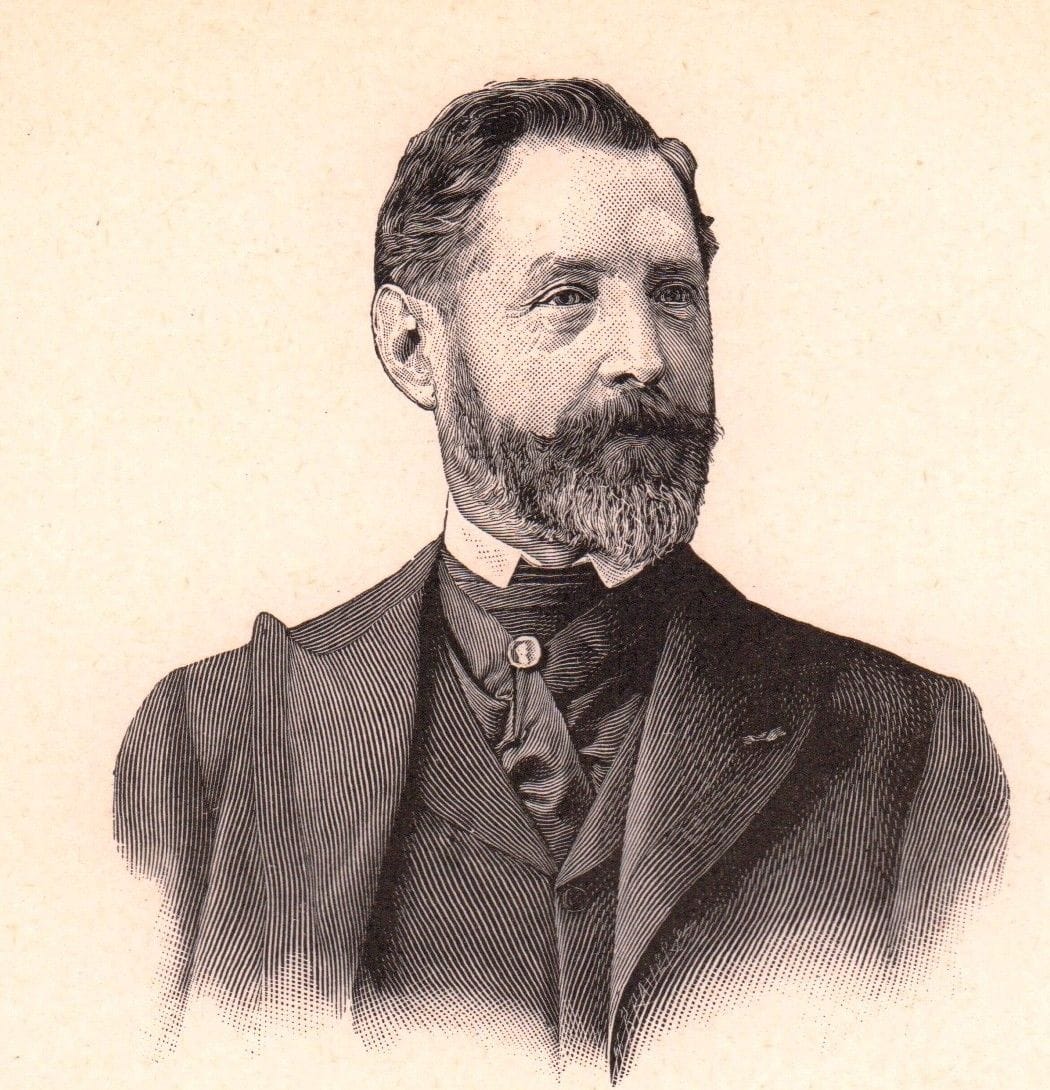
Jules Girardet (April 10, 1856 – January 25, 1938) was a French painter and illustrator of Swiss ancestry, born in Versailles. Coming from a family of artists, Girardet studied at the École des Beaux-Arts and under Alexandre Cabanel, a prominent academic painter. He established his career primarily in genre painting and historical scenes, exhibiting regularly at the Paris Salon from 1881. He won a silver medal at the 1889 Exposition Universelle and lived and worked in Boulogne-Billancourt.
Artist Style and Movement
Girardet worked predominantly in Academic style with a focus on genre painting, depicting intimate, narrative-rich scenes of everyday life. His works combine careful draftsmanship, keen observation of human behavior, and a refined palette that lends warmth and realism. Though he painted historical subjects, his genre scenes of family life, social interactions, and emotional moments are notable for their storytelling clarity and detail.
Artwork Profile / Notable Works
- Departure on Honeymoon: This painting captures a touching and atmospheric moment of a couple leaving for their honeymoon, illustrating themes of love, transition, and anticipation with delicate emotion and composition.
- The Siege of Saragossa: A historical composition reflecting Girardet’s engagement with dramatic historical narratives.
- The Route of Cholet and The Revolt of Fouesnant: These works portray dramatic and political moments tied to French history, emphasizing Girardet’s range beyond genre scenes.
- At the Edge of Lake Léman: A serene landscape painting held by the Museum of Berne, showcasing Girardet’s versatility beyond figures and scenes.
Jules Girardet remains recognized for his sensitive and richly detailed genre paintings that narrate daily life and historical events with academic rigor and emotional resonance. His contributions to French art of the late 19th and early 20th centuries have secured his place as a chronicler of human experience, blending narrative depth and technical mastery.