
Table of Contents
The Card Players
Theodoor Rombouts (c. 1620–1630)
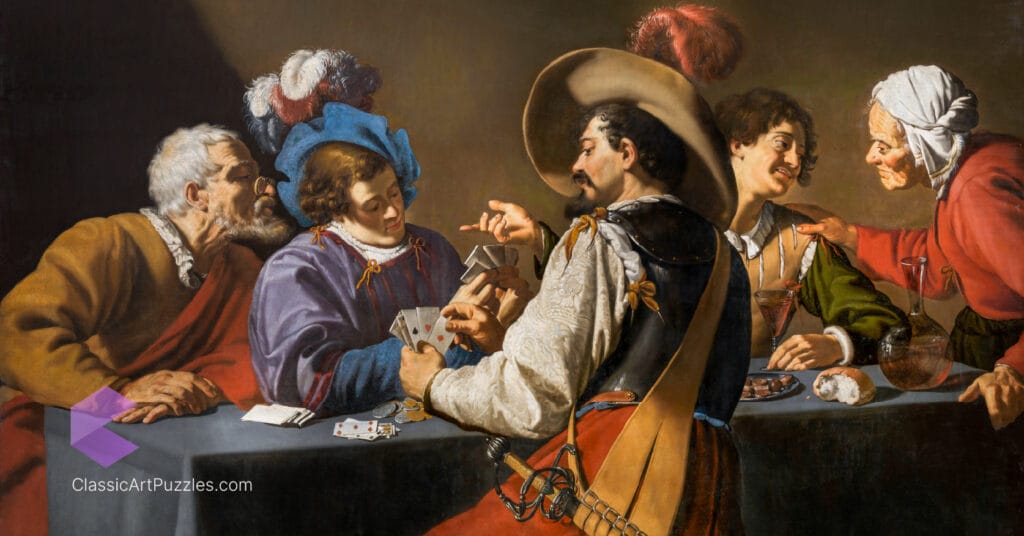
The table draws them close. Cards are held just high enough to be read, but not revealed. Hands pause between movement and rest, as if time itself has slowed to match the rhythm of play. Coins lie nearby, already committed, while food and drink wait without complaint. Nothing presses. This is not a moment of decision, but of attention.
Faces lean inward, not to conceal, but to share the small gravity of the game. Glances pass calmly. The space is tight, intimate, and contained. Whatever happens next will happen among people who already know one another well.
Painted in the early seventeenth century, The Card Players by Theodoor Rombouts belongs to a tradition of Flemish genre painting that turned its focus toward everyday social life. The work depicts a card game staged with restraint rather than agitation. Instead of directing the viewer toward moral judgment, the painting invites sustained looking, rewarding patience with balance, texture, and presence.
Key Facts
Artist: Theodoor (Theodor) Rombouts
Artist lifespan: 1597–1637
Origin: Flemish, born in Antwerp; admitted to the Antwerp Guild of Saint Luke in 1621
Title: The Card Players
Date: c. 1620–1630
Medium: Oil on canvas
Style: Flemish Caravaggism
Dimensions: 95 × 112 cm
Current location: Residenzgalerie Salzburg (inv. no. 431); related versions or variants in Antwerp and the Museo del Prado, Madrid
Artist
Theodoor Rombouts was active in Antwerp during the first half of the seventeenth century and is known for genre scenes depicting music-making, gaming, and social gatherings. Early in his career, he traveled to Italy, where he encountered the work of Caravaggio and painters influenced by him.
This exposure shaped Rombouts’s use of light and spatial compression. His figures often occupy shallow settings, bringing the viewer into close proximity with the scene. Rather than idealized types, he favored individualized faces and measured gestures drawn from observation.
Style and Technique
The Card Players is executed in oil on canvas with a confident yet restrained handling of paint. Flesh tones are warm, and shadows are used to shape form rather than to obscure it. Light moves deliberately across faces, fabrics, and objects, creating volume without theatrical contrast.
This approach reflects Italian Caravaggist influence while remaining rooted in Flemish traditions of clarity and finish. The painting avoids exaggerated drama. Its technique supports monumentality and calm rather than sudden action.
Subject Matters
The Card Players depicts a small group gathered closely around a table engaged in a card game. The figures are shown at half length, compressed into a shallow space that brings their interaction forward. Cards, coins, bread, wine, and glassware are visible, suggesting an ongoing game played within a social setting rather than a scene of excess.
The group includes several male figures and at least one female figure seated opposite a bearded man near the center. At the left edge of the composition, an older figure leans toward one of the players in conversation. The precise identification of each participant is not fixed, and the scene allows for some ambiguity in age and gender.
Rather than isolating a decisive moment, the painting presents card playing as a shared activity. Conversation, observation, and quiet engagement appear as important as the game itself.
Composition
The figures are arranged in a shallow arc around the table, enclosing the scene and drawing the viewer inward. No single figure dominates the composition. Attention moves evenly across faces and hands, guided by light and posture.
The table serves as a stabilizing axis, while gestures and glances create a gentle rhythm across the group. The background remains subdued, ensuring that focus stays on the social exchange rather than the setting.
Historical and Cultural Context
In seventeenth-century Flemish society, card games occupied a space between ordinary leisure and moral debate. Genre painters frequently used such scenes to explore social behavior, chance, and companionship.
While some artists emphasized disorder or deception, others presented card playing as a refined pastime. Rombouts’s treatment aligns with this latter approach, emphasizing sociability and composure rather than vice.
Identity, Meaning, and Interpretation
Most scholars identify the bearded man wearing the grand feathered hat as Theodoor Rombouts himself, and the woman in the blue bodice as his wife, Anna van Thielen. This identification significantly alters the reading of the painting. Rather than a group of strangers in a questionable tavern, the scene becomes a theatrical family portrait.
By placing himself and his wife at the center, Rombouts elevates the subject matter from a low-life genre scene to a sophisticated display of social standing and artistic confidence. The competition appears civilized rather than predatory. Authoritative sources, including curators involved in exhibitions at MSK Ghent, describe Rombouts’s figures as stately and calm.
The older figure at the left, often interpreted as a conspirator, can instead be read as a mentor or spectator offering advice within a familiar circle. Expensive clothing, a well-set table, and Rombouts’s relaxed expression suggest refinement over vice. The focus shifts away from moral warning toward elegant leisure and painterly display.
Many modern art historians view the work as a conversation piece, a format associated with Dutch and Flemish art that celebrates social ritual and cultivated interaction.
Editorial Commentary
There is a persistent tendency in art history to treat every Caravaggist painting as a crime scene. Shadows are read as evidence, gestures as confessions, and card games as inevitable setups for deceit. In the case of Rombouts, this approach obscures the painting’s true ambition.
Light and shadow here are tools of theatrical beauty, not moral alarm. The figures are monumental, not furtive. When we stop searching for a villain, the painting reveals itself as a celebration of civilized presence.
It is implausible to imagine that an artist who placed himself and his wife at the heart of this composition intended to depict his own household as common swindlers. This is not a warning against vice, but a declaration of dignity. The card game becomes an expression of intellectual play and social harmony, rend
More About Artist
Theodoor Rombouts (1597–1637) was a Flemish Baroque painter who is considered the most original and important representative of Flemish Caravaggism. His work stands out for its dramatic use of light and shadow, and its focus on vibrant, realistic genre scenes that often portray lively gatherings, musicians, and card players.
Life and Artistic Influences
Born in Antwerp, Rombouts received his early training under the master Abraham Janssens, one of the first Flemish painters to adopt a Caravaggio-influenced style. From 1616 to 1625, Rombouts lived and worked in Rome, where he was exposed to the revolutionary art of Caravaggio and his followers, particularly Bartolomeo Manfredi. This period was formative, shaping his signature style of using stark contrasts of light and shadow (tenebrism) and depicting half-length figures in theatrical compositions.
After his return to Antwerp in 1625, Rombouts became a master of the Guild of St. Luke. He continued to create his monumental genre paintings, but as the Caravaggist style waned, his later works adopted a lighter palette and more refined technique, reflecting the influence of other prominent Flemish painters like Peter Paul Rubens.
Artwork Profile
Rombouts’s best-known works are his large-scale genre paintings, which are filled with energy, narrative detail, and a sense of immediacy.
- The Card Players (c. 1625): This is one of Rombouts’s most celebrated and characteristic paintings. The scene, created shortly after his return from Italy, is a masterclass in tenebrism. A single light source illuminates a group of men gathered around a table, highlighting their expressions of concentration and deceit. The painting masterfully captures the drama and tension of a gambling game, all while hinting at the moralizing themes common in such works.
- The Quack Tooth Puller (c. 1620–1625): This painting, housed in the Prado Museum, is another prime example of Rombouts’s Caravaggesque style. It depicts a chaotic and lively street scene centered on a “quack” or charlatan tooth puller in the midst of his gruesome work. The crowd’s diverse expressions—ranging from pain and horror to curiosity and amusement—are captured with unflinching realism. The dramatic lighting, the detailed costumes, and the theatrical composition all serve to create a powerful and engaging narrative.
Rombouts’s work is a crucial link between the revolutionary Italian Baroque and the rich tradition of Flemish painting. His ability to blend Caravaggio’s dramatic light.