

Table of Contents
Overview
In Flower Sellers (1885) by Jules Girardet (1856–1938), two cheerful young women offer blossoms to a passing gentleman, their laughter bright against the quiet architecture of a sunlit street. One reaches out playfully, her apron brimming with color, while he, flustered and amused, tips his hat and retreats with polite alarm. The cobblestones shimmer with petals, turning the small exchange into a dance of humor and charm.
Girardet, a French painter of the Genre Painting / Rococo Revival tradition, was known for his animated scenes of daily life infused with wit and elegance. Here, he balances 18th-century grace with 19th-century realism, composing his figures with theatrical precision yet natural ease. The gentle folds of fabric, the flush of faces, and the polished stone evoke both artifice and authenticity.
Beneath the laughter lies a gentle observation of human connection. The scene celebrates spontaneity, civility, and the joy of small encounters — a fleeting comedy of manners preserved in light and color.
The Blossoms and the Gentleman
In Flower Sellers, painted in 1885, French artist Jules Girardet brings together wit, elegance, and a touch of theatre. Known for his genre scenes rich with narrative and charm, Girardet offers here a vibrant moment of street life—caught between flirtation and comedy, wrapped in the fragrant cheer of fresh blooms.
With his background in academic realism and flair for detail, Girardet makes the ordinary feel like a scene from a lively play. And in this painting, we step into a light-hearted act—where flowers are not only sold, but cleverly used.
A Bouquet and a Smile
In the heart of a quiet European street, under the shadow of elegant arches, two flower girls approach an older gentleman. One offers him a playful smile, the other stretches a yellow bouquet toward him with teasing intent. Between them is a large basket overflowing with blooms—roses, daisies, and bright greenery.
The man steps back in mock protest, his body twisting in surprise, a red umbrella swinging in one hand while the other lifts in defense. His powdered wig and stockings mark him as a man of status—or perhaps simply someone unaccustomed to street spontaneity.
Other townsfolk linger in the background, absorbed in their own affairs, unaware of the spirited scene unfolding near the florist’s stand.
Roses, and Charm
While the painting delights with humor and color, it also hints at something deeper: the soft power of youth, beauty, and nature.
The girls are not passive sellers but bold characters, shaping the interaction with confidence and laughter. The flowers they carry—symbols of innocence, affection, and play—become tools of flirtation and joy.
Girardet doesn’t mock the gentleman; instead, he highlights the meeting of worlds: the formal and the fresh, the cautious and the carefree.
It’s a celebration of life’s lighter moments, of connection found in surprise, and of joy in the unexpected.
A Moment Caught in Time
The scene is alive with movement: the swirl of the maid’s dress, the startled gesture of the gentleman, the rhythm of cobblestones, and the softness of petals scattered underfoot. There’s storytelling in every fold of fabric and every tilt of the head.
Color plays a key role—deep greens, blooming reds, creamy yellows, and the blushing pink of the seller’s skirt—drawing the eye across the canvas in cheerful motion.
Girardet paints not only what is seen, but what is felt: the teasing joy of street encounters, the laughter behind commerce, and the beauty of the ordinary, made memorable.
The Artist
Jules Girardet (1856–1938) was a French academic painter known for his refined genre scenes and historical interiors. A pupil of Jean-Léon Gérôme at the École des Beaux-Arts, Girardet mastered academic draftsmanship while infusing it with warmth and humor. He frequently portrayed gallant conversations, domestic rituals, and playful exchanges, often set in settings inspired by 18th-century France.
His work forms part of the Rococo Revival, a movement that reimagined the manners, costumes, and elegance of pre-Revolutionary France through modern realism. Girardet exhibited regularly at the Paris Salon, where critics praised his control of tone and his gentle narrative wit. Paintings such as A Distraction, Departure on Honeymoon, and The Flower Sellers show his enduring fascination with charm, civility, and the poetry of everyday life.
The Painting Story
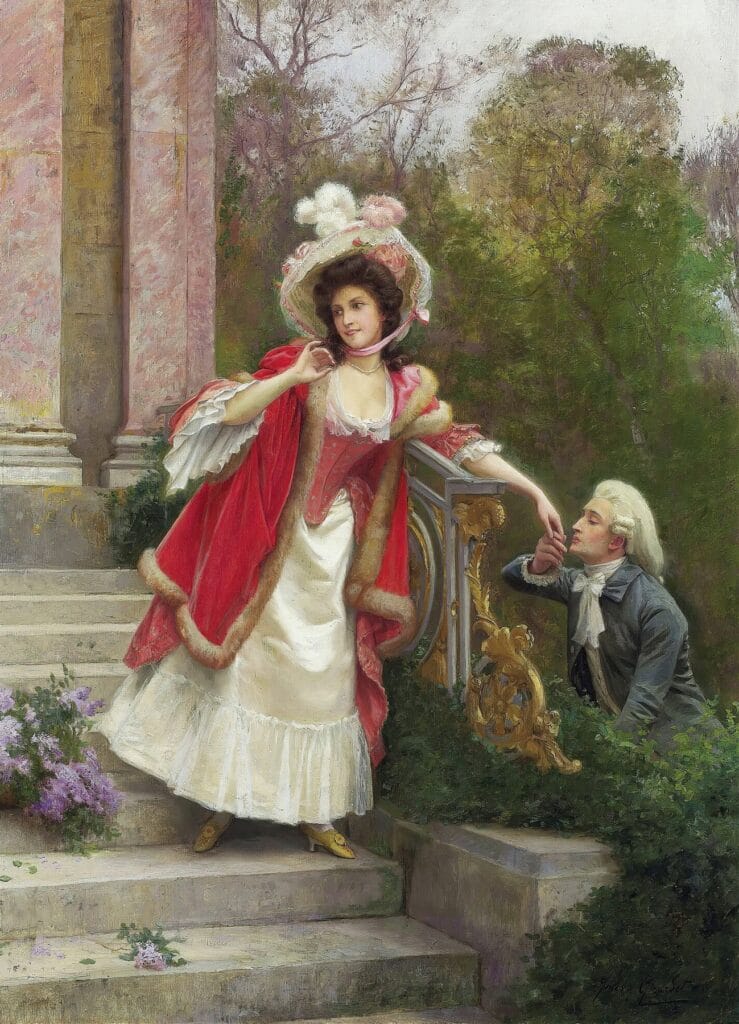
Two flower sellers stand by a quiet street corner. Their baskets overflow with roses and lilacs, their smiles full of warmth and confidence. An older gentleman, dressed in formal coat and holding a crimson umbrella, pauses mid-step as one woman leans forward, offering him a bouquet with teasing insistence. His hat tips, his composure trembles — gallantry meets surprise.
The setting is intimate but alive. Light spills across stone walls, catching on ribbons, petals, and folds of fabric. The scene has no villains, no moral crisis — only laughter and civility in gentle contrast. Girardet gives us a story of charm meeting restraint, the brief spark of connection between everyday lives.
Artistic Context
The Flower Sellers reflects the spirit of Genre Painting / Rococo Revival, where artists rediscovered the wit and refinement of 18th-century art but infused it with the precision of 19th-century realism. For Girardet, this meant exploring how gestures and social rituals reveal personality.
In a century marked by industrial progress, such paintings offered visual refuge — elegant worlds where manners, humor, and human warmth still ruled. Unlike earlier Rococo painters such as Fragonard or Boucher, Girardet’s vision is grounded in sincerity rather than fantasy. His humor is gentle, never mocking, and his affection for his subjects keeps the scene human, not idealized.
Composition and Subject Matters
Girardet constructs the composition with quiet rhythm. The women form a lively diagonal that guides the viewer’s eye toward the gentleman, whose posture adds a counterbalance of restraint. The warm earth tones of the building contrast with the cool palette of their dresses — rose, ivory, and sky-blue. The cobblestones shimmer with reflected light, giving the painting a sense of air and movement.
No gesture is wasted. The raised umbrella, tilted hat, and cascading flowers create a choreography of civility and surprise. It is a masterclass in spatial simplicity, where interaction and color, rather than architecture, carry the story.
Style and Technique
Girardet’s technique shows the polished discipline of French academic painting softened by warmth and atmosphere. His brushwork is smooth and layered, producing delicate transitions of tone that animate skin, cloth, and stone. The light, likely filtered midday sunlight, falls evenly — neither theatrical nor harsh.
His color harmony relies on contrast between muted architecture and vivid accents: the pink blossoms, crimson umbrella, and silvery gowns. The result is a balanced realism that feels alive without losing its grace. Girardet’s sensitivity to posture and texture gives each figure a distinct personality within a cohesive whole.
Symbolism and Meaning
While humorous, The Flower Sellers carries subtle reflections on civility and connection. The flowers symbolize openness — nature offered freely — while the gentleman’s restraint hints at politeness as both barrier and bridge. The women’s laughter transforms commerce into companionship, showing how warmth dissolves social distance.
Girardet’s message is gentle but enduring: that humanity flourishes in the smallest encounters. No sermon or allegory intrudes — only a smile shared between strangers, preserved in paint.
Flower Sellers – Jules Girardet
Laughter rings between cobblestones,
a bouquet becomes a dare.
He hesitates, she leans closer —
a street turned stage,
where manners bloom
and the air smells faintly of courage and roses.
More About Artist
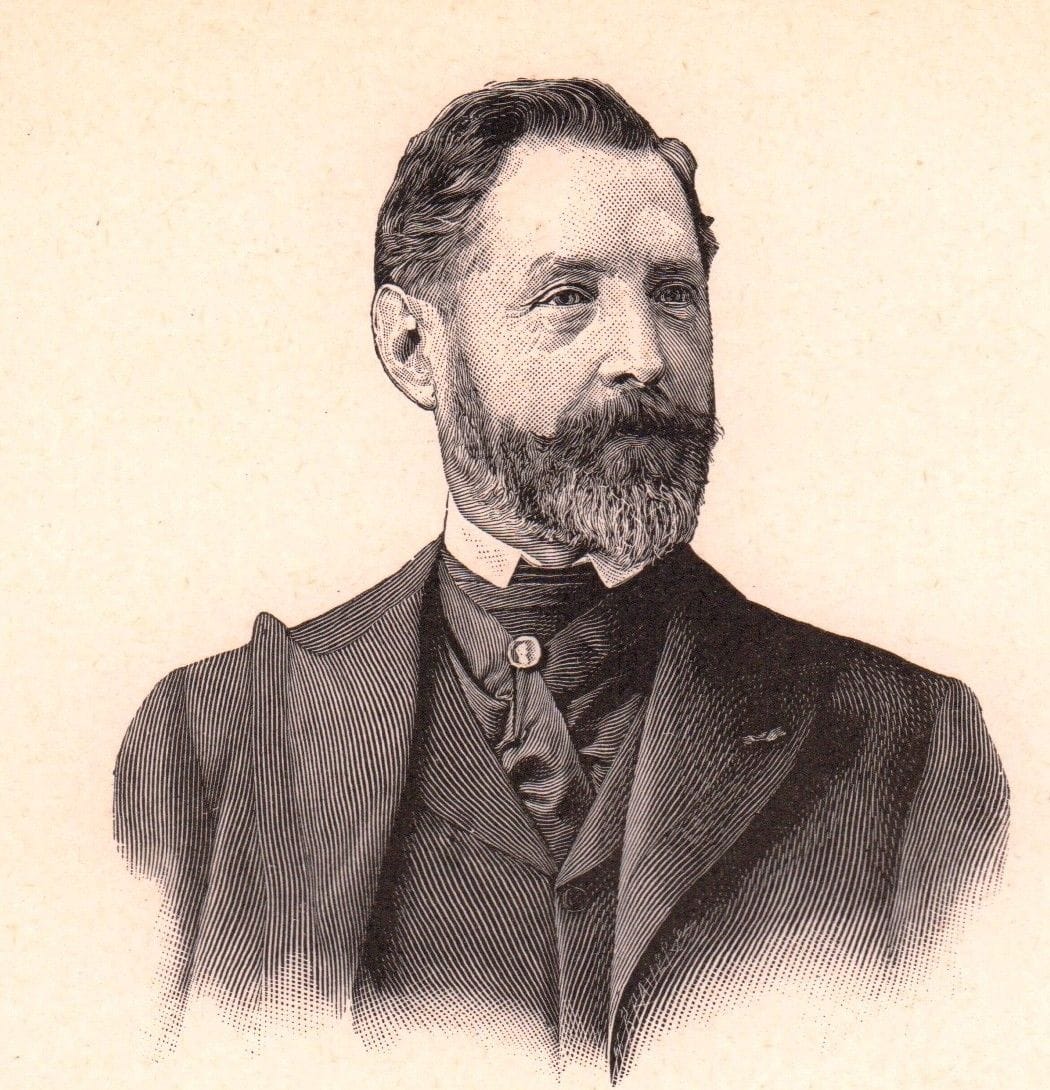
Jules Girardet (April 10, 1856 – January 25, 1938) was a French painter and illustrator of Swiss ancestry, born in Versailles. Coming from a family of artists, Girardet studied at the École des Beaux-Arts and under Alexandre Cabanel, a prominent academic painter. He established his career primarily in genre painting and historical scenes, exhibiting regularly at the Paris Salon from 1881. He won a silver medal at the 1889 Exposition Universelle and lived and worked in Boulogne-Billancourt.
Artist Style and Movement
Girardet worked predominantly in Academic style with a focus on genre painting, depicting intimate, narrative-rich scenes of everyday life. His works combine careful draftsmanship, keen observation of human behavior, and a refined palette that lends warmth and realism. Though he painted historical subjects, his genre scenes of family life, social interactions, and emotional moments are notable for their storytelling clarity and detail.
Artwork Profile / Notable Works
- Departure on Honeymoon: This painting captures a touching and atmospheric moment of a couple leaving for their honeymoon, illustrating themes of love, transition, and anticipation with delicate emotion and composition.
- The Siege of Saragossa: A historical composition reflecting Girardet’s engagement with dramatic historical narratives.
- The Route of Cholet and The Revolt of Fouesnant: These works portray dramatic and political moments tied to French history, emphasizing Girardet’s range beyond genre scenes.
- At the Edge of Lake Léman: A serene landscape painting held by the Museum of Berne, showcasing Girardet’s versatility beyond figures and scenes.
Jules Girardet remains recognized for his sensitive and richly detailed genre paintings that narrate daily life and historical events with academic rigor and emotional resonance. His contributions to French art of the late 19th and early 20th centuries have secured his place as a chronicler of human experience, blending narrative depth and technical mastery.