

Table of Contents
Overview
A young couple stands at the foot of a grand Parisian doorway. The bride, radiant in white satin and a crimson cloak, receives a farewell kiss from her mother as her husband waits, holding her hand. A coach stands ready, its wheels bright red on the cobbled street, while family members wave from the balcony above.
In Departure on Honeymoon, Jules Girardet captures a moment of joyful transition — the first step into married life. Painted in the late 19th century, this work combines Rococo elegance with Victorian sentiment, reviving the grace and gaiety of 18th-century France.
Girardet transforms farewell into celebration: a symphony of color, costume, and affection framed in perfect light.
Departure on Honeymoon – Jules Girardet, late 19th century – Genre Painting
The doorway is grand, the moment tender. A young couple, dressed in the finest fashions of the 18th century, pauses on the cobbled step as love and laughter swirl around them. Painted by Jules Girardet—master of theatrical, romantic scenes—Departure on Honeymoon is a celebration of beginnings, farewells, and the elegant charm of another age.
Though likely painted in the late 19th or early 20th century, Girardet sets the scene in the Rococo past—a time of powdered wigs, corsets, and feathered hats. It’s not historical accuracy he’s after, but a feeling: festive, flirtatious, and full of life.
The Scene
The coach is waiting. A red-wheeled carriage stands ready in the street, its rear basket packed with boxes and ribbons. The groom, in rust-orange coat and white stockings, gently guides his new bride down the steps. She is radiant in white silk and a scarlet-lined cloak trimmed in fur. One hand gathers her skirt, the other clasps his.
Beside her, a masked figure leans in for a final kiss—perhaps a sister, friend, or confidante bidding her farewell in the dramatic fashion of the day. Above, from the balcony, a group of onlookers waves and cheers with playful delight. Even the little white dog at her feet adds to the sense of bustling excitement.
Girardet choreographs it all with a theatrical eye. Each gesture, gaze, and costume is composed like a scene on stage.
A Kiss Before the Journey
While this may seem like a simple depiction of aristocratic romance, it’s more than that. Girardet captures the emotional threshold between old life and new—the moment when one world recedes, and another opens.
There’s nostalgia here, too. By dressing his figures in Rococo attire, Girardet invites us to look back—perhaps not to history as it truly was, but to how we imagine it: refined, romantic, and joyful. It’s the same impulse that drives costume balls and classic novels, a longing for elegance and emotion unmarred by modern complexity.
And at its heart is a universal theme: the ritual of goodbye and the hope of what comes next.
A Moment Caught in Time
You can almost hear the rustle of fabric, the click of the carriage wheel, the laughter from above. It’s a painting that moves, even though everything is still. The young woman’s sideways glance, the man’s poised hand, the curious dog—they all freeze this moment like a memory captured in soft light.
Girardet gives us not just a glimpse into the past, but a glimpse into joy. Into new love. Into the simple magic of departure, with all its fluttering nerves and sparkling promises.
Artist
Jules Girardet (1856–1938) was a French academic painter from an artistic family. Trained at the École des Beaux-Arts under Alexandre Cabanel, Girardet became known for his historical and genre scenes that celebrated daily life, costume, and romance.
He often worked in the Rococo Revival style, a late 19th-century movement that rediscovered the charm of the 18th century — powdered wigs, graceful gestures, and poetic domesticity. Yet Girardet’s art was more than nostalgic: his characters feel real, his compositions animated by warmth and motion.
Throughout his career, he exhibited at the Paris Salon, where works like Departure on Honeymoon, The Suitor, and The Young Musician delighted audiences with their fine detail, human emotion, and theatrical light.
The Story
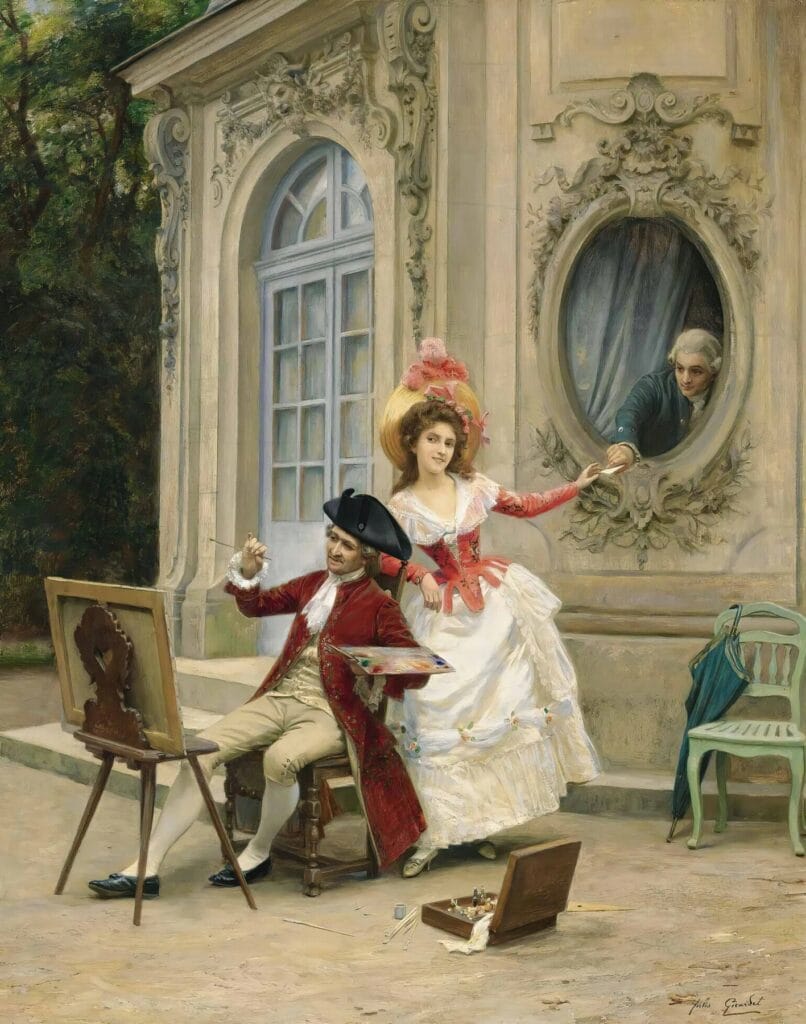
The painting unfolds outside a grand townhouse, its ornate doorway adorned with carved stone and wrought iron. A carriage waits on the cobblestone street, its wheels painted red and boxes strapped behind — the couple’s luggage for their journey.
On the steps, the bride leans forward for a last kiss from her mother, who is wrapped in white lace. The groom, dressed elegantly in tan and rose hues, extends his hand to assist her. A small white dog watches eagerly at their feet, tail raised.
Behind them, two women lean from the balcony, waving farewell. The air feels full of laughter, affection, and excitement — the bittersweet joy of parting.
Girardet captures the essence of a new beginning — not dramatic, but deeply human, filled with grace and anticipation.
Artistic Context
By the late 19th century, European audiences were captivated by the Rococo revival, which celebrated the refined manners and fashions of pre-Revolutionary France. Artists like Jules Girardet, Jean-Georges Vibert, and Vittorio Reggianini created genre scenes set in the 18th century that blended nostalgia with humor and romance.
Girardet’s Departure on Honeymoon belongs to this refined tradition, yet it differs from pure pastiche. His figures move naturally, his colors breathe with sunlight, and his tone is affectionate rather than idealized.
The 19th century’s fascination with the Rococo era wasn’t just aesthetic — it reflected a yearning for elegance, intimacy, and civility in an increasingly industrial world. Girardet painted that longing beautifully, one gesture at a time.
Composition and Subject Matters
The composition is both theatrical and balanced. Girardet arranges the scene as a gentle diagonal: the mother at the door, the bride descending the steps, the groom reaching forward, and the carriage awaiting below. This movement leads the viewer’s eye seamlessly from intimacy to departure.
The architecture frames the scene with grandeur, while the cobbled street anchors it in realism. The dog and the waving figures provide rhythm and liveliness — secondary notes in this visual symphony of farewell.
Girardet’s mastery of costume and texture brings the period to life: the silk of the bride’s dress, the lace shawl, the polished leather shoes, and the satin ribbons shimmer with authenticity. Every surface tells part of the story.
Style and Technique
Girardet painted with precision and warmth, uniting academic technique with narrative grace. His brushwork is smooth and layered, allowing fabrics and stonework to feel tangible yet soft.
The color palette is radiant and harmonious: ivory, rose, gold, and warm gray create an atmosphere of optimism and refinement. Light filters evenly across the facade, enhancing both architectural depth and emotional warmth.
Girardet’s figures are sculpted through gentle transitions of tone rather than hard edges, a hallmark of late academic realism. The result is vivid naturalism, yet full of elegance — the charm of the 18th century seen through 19th-century eyes.
Symbolism and Meaning
Departure on Honeymoon is more than a historical vignette — it’s a visual poem about love, family, and passage.
- The carriage symbolizes transition — the journey from one stage of life to another.
- The kiss embodies blessing, the bridge between home and independence.
- The dog represents loyalty and continuity — love that follows wherever life leads.
- The waving figures echo the joy of community, reminding us that every new beginning is shared.
Through these details, Girardet tells a universal story: love as movement, connection, and promise.
Departure on Honeymoon: Farewell Kisses
Laughter at the window,
a kiss by the door,
a carriage waiting —
wheels of hope on cobbled stone.
Silks rustle, hearts tremble,
and in one bright step,
love becomes a journey.
More About Artist
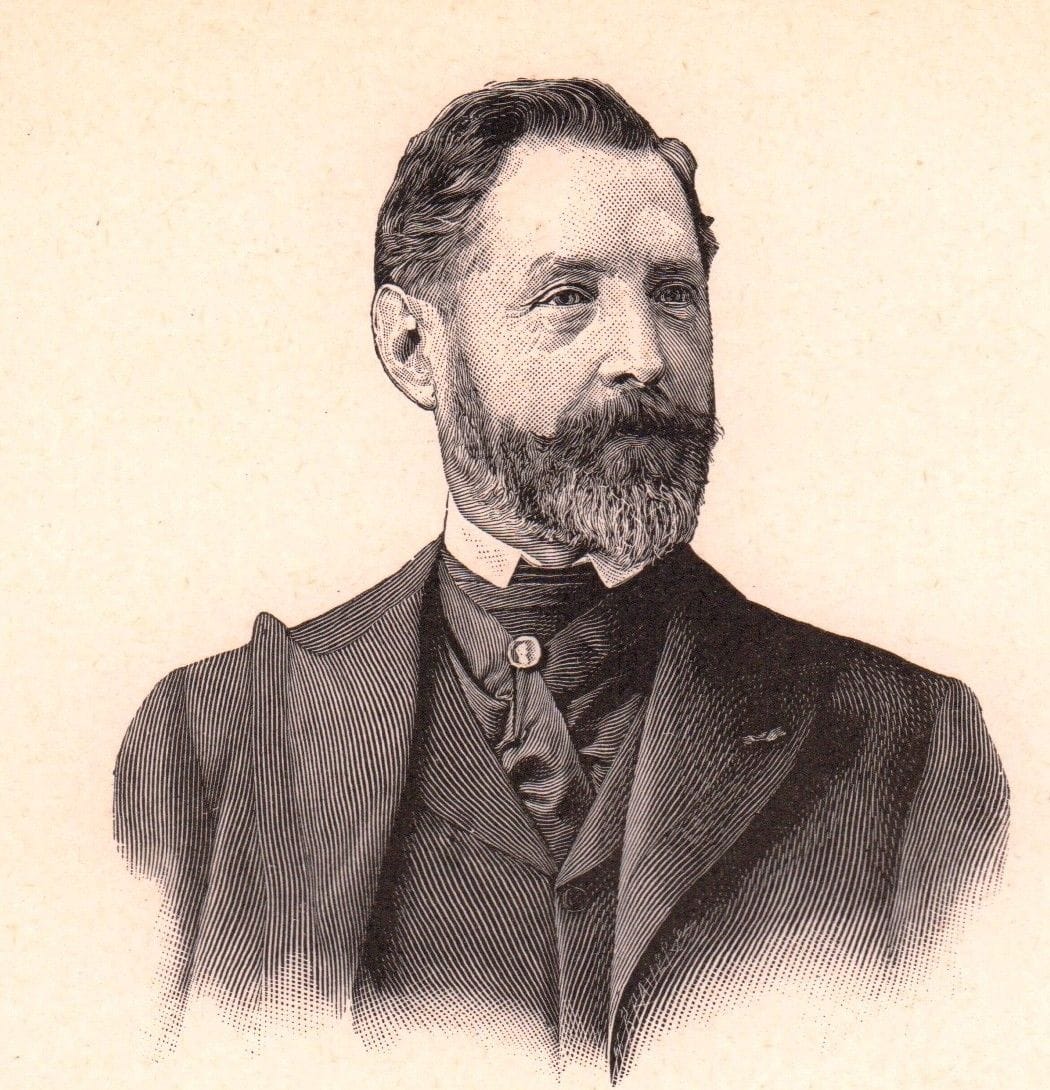
Jules Girardet (April 10, 1856 – January 25, 1938) was a French painter and illustrator of Swiss ancestry, born in Versailles. Coming from a family of artists, Girardet studied at the École des Beaux-Arts and under Alexandre Cabanel, a prominent academic painter. He established his career primarily in genre painting and historical scenes, exhibiting regularly at the Paris Salon from 1881. He won a silver medal at the 1889 Exposition Universelle and lived and worked in Boulogne-Billancourt.
Artist Style and Movement
Girardet worked predominantly in Academic style with a focus on genre painting, depicting intimate, narrative-rich scenes of everyday life. His works combine careful draftsmanship, keen observation of human behavior, and a refined palette that lends warmth and realism. Though he painted historical subjects, his genre scenes of family life, social interactions, and emotional moments are notable for their storytelling clarity and detail.
Artwork Profile / Notable Works
- Departure on Honeymoon: This painting captures a touching and atmospheric moment of a couple leaving for their honeymoon, illustrating themes of love, transition, and anticipation with delicate emotion and composition.
- The Siege of Saragossa: A historical composition reflecting Girardet’s engagement with dramatic historical narratives.
- The Route of Cholet and The Revolt of Fouesnant: These works portray dramatic and political moments tied to French history, emphasizing Girardet’s range beyond genre scenes.
- At the Edge of Lake Léman: A serene landscape painting held by the Museum of Berne, showcasing Girardet’s versatility beyond figures and scenes.
Jules Girardet remains recognized for his sensitive and richly detailed genre paintings that narrate daily life and historical events with academic rigor and emotional resonance. His contributions to French art of the late 19th and early 20th centuries have secured his place as a chronicler of human experience, blending narrative depth and technical mastery.