

Table of Contents
Overview
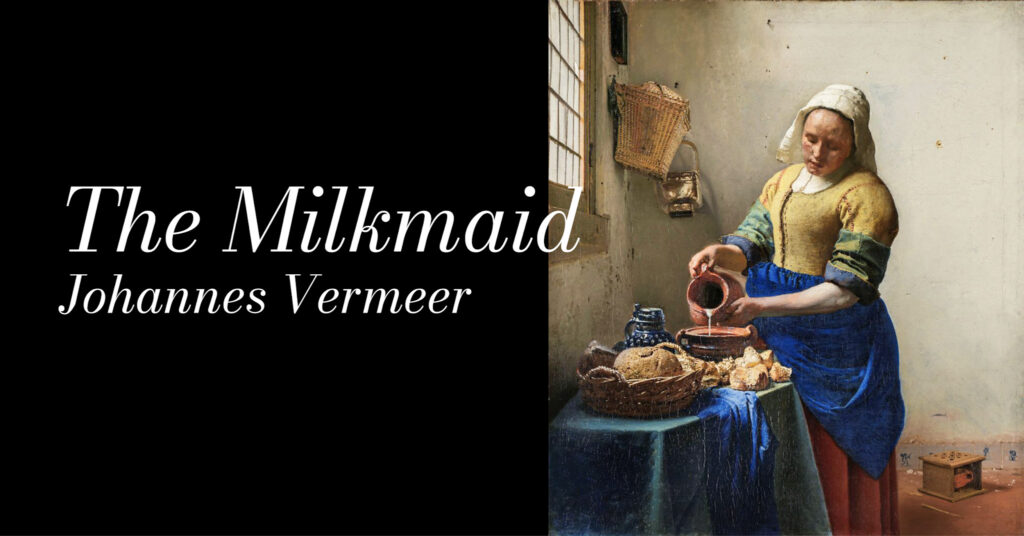
A woman stands by a window, pouring milk with deliberate care. Her gesture is steady, her focus complete. Light falls across her figure, warming the bread, the jug, and her yellow bodice with quiet radiance.
In The Milkmaid (c. 1657–1658), Johannes Vermeer turns a simple household task into a scene of luminous devotion. The woman’s stillness seems to slow time itself — the act of pouring milk becomes almost sacred.
Through subtle light, texture, and composition, Vermeer transforms ordinary life into poetry. This humble maid, absorbed in her work, stands as one of art’s most enduring symbols of dignity and peace.
The Milkmaid – Johannes Vermeer, c. 1657–1658 – Genre Painting, Dutch Baroque
Artist
Johannes Vermeer (1632–1675) was a Dutch painter from Delft, celebrated for his intimate domestic interiors bathed in natural light. Though he produced only about 35 known paintings, each is a masterpiece of quiet observation and refined technique.
Vermeer’s subjects were drawn from daily life — women reading letters, playing instruments, or performing household tasks — yet he rendered them with timeless grace. His genius lay not in grandeur but in presence: the way light, color, and space could reveal the soul of the ordinary.
During his lifetime, Vermeer worked slowly and sold modestly. His rediscovery in the 19th century revealed him as one of the great masters of realism — a painter of light, silence, and the beauty of human attention.
The Story Within the Scene
The setting is a modest kitchen in Delft. A young maid stands near a window, pouring milk into a ceramic bowl. On the table lie a loaf of bread, pieces of crust, and a woven basket. The morning light glows softly through the window’s small panes, illuminating the rough plaster wall and the smooth glaze of the jug.
The woman’s sleeves are rolled up, her posture firm, her eyes lowered. Her task is simple, yet Vermeer elevates it into a moment of reverence. There’s no audience, no pretense — just work done with patience and care.
In the quiet of this kitchen, labor becomes grace. The act of nourishment — pouring milk — becomes a meditation on life itself.
Artistic Context
In 17th-century Holland, genre painting reached a level of sophistication never before seen. Artists like Pieter de Hooch, Gerard Dou, and Gabriel Metsu explored domestic life as a moral and aesthetic subject.
Vermeer’s The Milkmaid belongs to this tradition but surpasses it in depth. Where others told moral tales or sentimental scenes, Vermeer offered contemplation. His work carries no judgment — only truth.
At a time when the Dutch Republic prized modesty, cleanliness, and labor, Vermeer gave those virtues a face. The painting is not about servitude but about presence — the quiet power of honest work illuminated by light.
Composition and Subject Matters
Vermeer composes the scene with geometric precision. The window on the left provides the sole light source, casting a diagonal beam across the figure and table. The maid’s sturdy form anchors the composition, while her bent arms and the milk’s stream create subtle movement.
The table, draped in blue cloth, provides both depth and symbolism — blue was Vermeer’s sacred color of serenity. The wall behind her is bare but alive with light, emphasizing the contrast between simplicity and richness.
Every detail — the wicker basket, the earthenware jug, the rough bread — has been painted with reverence. These humble objects become emblems of abundance and gratitude.
Style and Technique
Vermeer’s technique in The Milkmaid is a masterclass in controlled realism. He applied thin glazes of oil paint, layering colors to achieve the soft diffusion of light characteristic of his work.
Notice the luminous balance of yellow, blue, and red, a triad that gives the painting its harmony. The thick impasto on the bread crusts catches light like real crumbs; the milk’s stream is so precise that it seems to move.
Vermeer’s optical realism — possibly aided by a camera obscura — never feels mechanical. His aim was not imitation, but essence: to reveal beauty through seeing truthfully.
The result is both physical and spiritual — a painting that breathes.
Symbolism and Meaning
Though rooted in realism, The Milkmaid carries quiet layers of symbolism.
- Milk and bread signify nourishment and charity — virtues of domestic virtue and care.
- The open window suggests purity and divine illumination.
- The maid’s concentration reflects moral steadfastness — honest labor as spiritual fulfillment.
In the Dutch moral climate of the time, maids often symbolized temptation; Vermeer reverses that trope. His milkmaid is not seductive but sacred — an icon of integrity and inner peace.
The painting thus becomes a meditation on faith in daily life: the holiness of work done with love.
The Milkmaid: A Room of Her Own
Light rests on her sleeves,
on bread, on milk, on air.
A humble act becomes eternal —
grace poured from clay.
In her stillness, time stops breathing,
and the world begins again in silence.
More About the Artist
Johannes Vermeer (1632–1675), a Dutch painter from the city of Delft, is widely regarded as one of the most masterful painters of the Dutch Golden Age. Unlike contemporaries who were prolific and traveled widely, Vermeer lived a relatively quiet life, producing a small but exquisite body of work—only about 36 paintings survive—that has earned him the title “The Sphinx of Delft” due to the mystery surrounding his life and techniques.
Mastery of Light and Atmosphere
Vermeer’s genius lies in his unparalleled ability to capture the subtle effects of light. His paintings are not simply illuminated; they feel as though they are filled with a serene, pearlescent light. He often depicted a single window on the left side of the canvas as the primary light source, creating a soft, diffused glow that gives his interiors a sense of peace and intimacy. This technique, a departure from the dramatic tenebrism of Caravaggio, allows him to meticulously render the textures of objects, the folds of fabric, and the gentle shadows on a person’s face.
Subject and Style
While he began his career with large-scale biblical and mythological scenes, Vermeer is best known for his genre paintings—depictions of everyday domestic life. His subjects are often women absorbed in quiet, contemplative activities: reading a letter, playing a musical instrument, or pouring milk. These seemingly simple moments are imbued with a sense of quiet dignity and psychological depth. His paintings are not overtly narrative; instead, they invite the viewer to contemplate a single, suspended moment in time.
Technical Innovations and “The Camera Obscura”
Vermeer’s extraordinary realism and his signature “circles of confusion”—small, blurred highlights on shiny surfaces—have led many art historians to speculate that he used a camera obscura, a precursor to the modern camera. This device projects an image from an outside scene onto a surface inside a dark room. While he likely did not trace the images directly, the use of such an optical tool would have helped him understand and render the effects of light, perspective, and depth of field with almost photographic precision.
Notable Works
Vermeer’s small oeuvre includes some of the most beloved paintings in art history:
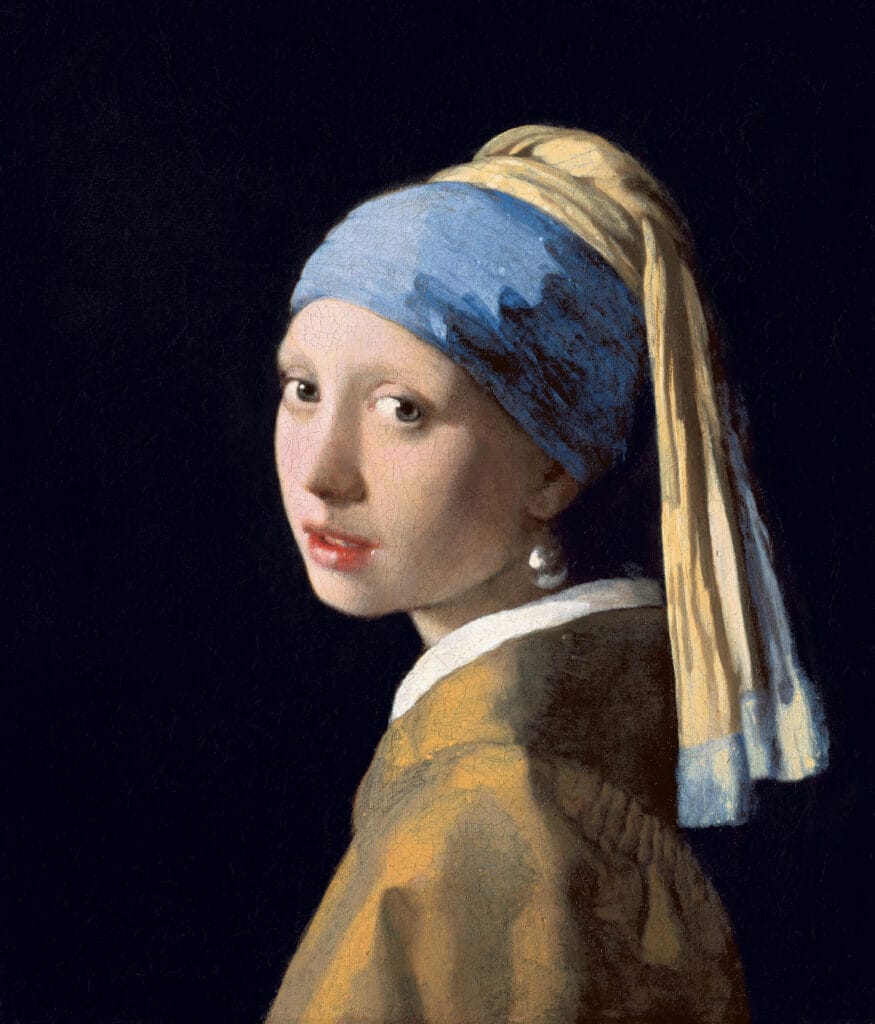
- Girl with a Pearl Earring: A captivating “tronie” (a study of a face) that, through its striking use of light and the subject’s enigmatic expression, has become one of the most famous paintings in the world.
- The Milkmaid: Celebrated for its remarkable rendering of light and texture, this painting transforms a simple domestic chore into a monument of quiet strength and beauty.
- View of Delft: One of only two surviving landscapes by the artist, this painting is a masterpiece of Dutch Realism, capturing the city’s atmosphere with an incredible sense of scale and detail.
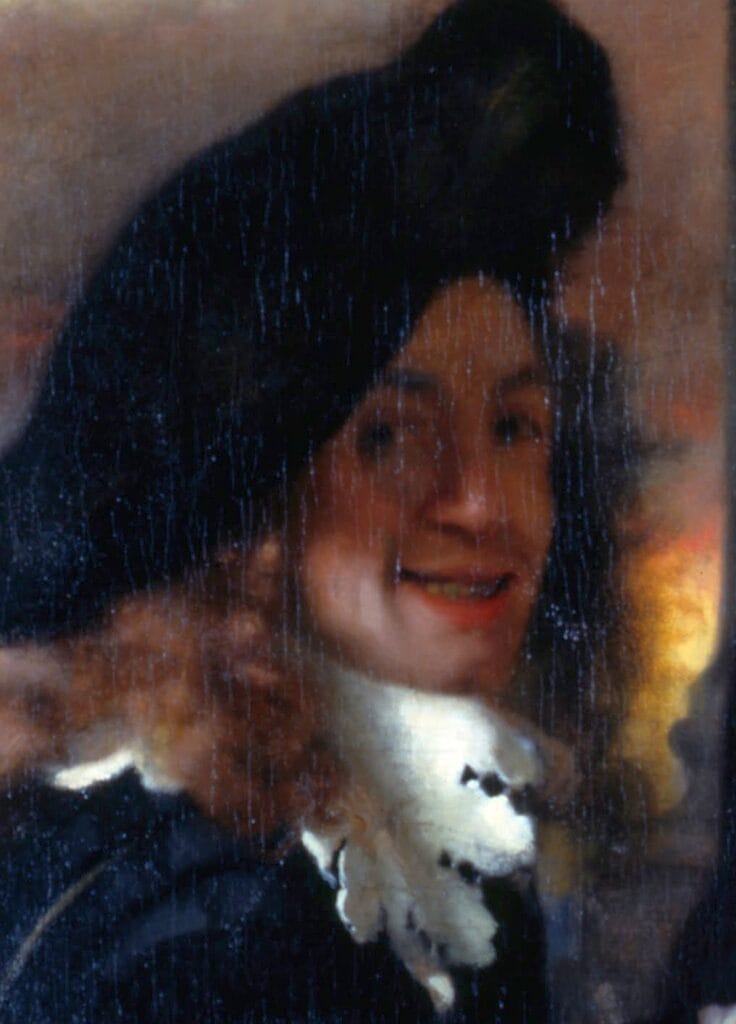
- The Art of Painting: An allegorical work that many consider to be Vermeer’s most significant. It shows a painter at his easel (believed to be Vermeer himself) in the act of creation, a profound statement on the value and importance of art.
Vermeer’s influence has grown immensely since his rediscovery in the 19th century. His meticulous technique, profound sense of stillness, and ability to elevate the mundane to the magnificent continue to captivate audiences worldwide.