
Table of Contents
The Art of Painting
The True North
Let them take the chairs.
Even the silver spoons and the heavy oak table.
But never this.
My wife, Catharina, stands in the doorway. She carries the weight of eleven children waiting for bread that does not come easily. She says nothing. She does not need to. One painting could quiet the baker. One sale could warm the house through winter.
But I could not.
I made a painting of a shadowed room where my dignity lives. The girl by the window is dressed in blue, crowned with leaves, holding history in her hands. To others she is a model. To me she is the reason I stay at the easel.
This painting is not for trade. It is my witness. It says that painting belongs with thought, with memory, with the careful keeping of human meaning.
When Vermeer passed, the house grew louder, not quieter. Papers arrived. Doors opened without asking. Hands inventoried what remained. The painting stayed where it always stood, leaning against the wall, watching.
Catharina fought for it. She did not hide silver or linens. She moved the painting instead. She risked punishment to protect it. She held that canvas as if it were the last place where her husband still breathed.
But debt had no patience. The law came anyway. The girl in blue was taken from the room. She was carried into daylight and placed among numbers and bids.
And still, the truth remains.
There was once a room where time stopped.
And someone believed it mattered enough to hold.
The Room
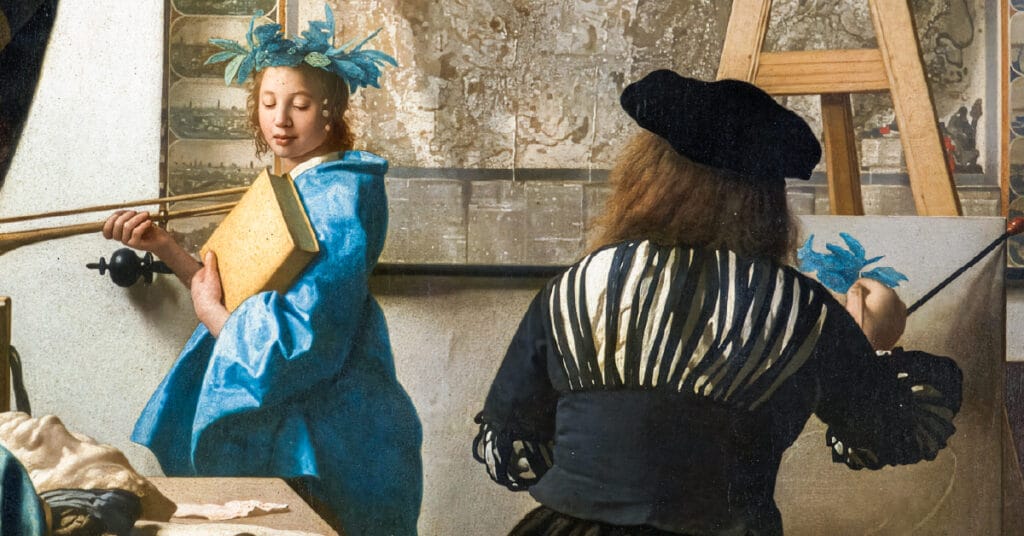
A painter sits with his back to us, brush poised, body turned slightly toward his subject. A young woman stands calmly before him, holding the attributes of Clio, the muse of history. Light enters from the left, touching fabric, map, and floor with quiet precision. A heavy curtain has been pulled aside, as if we have arrived late and must not disturb what is already underway.
Everything feels deliberate. Nothing moves. The room breathes.
Painted around 1666 to 1668, *The Art of Painting* by Johannes Vermeer depicts an artist at work in his studio, painting a model dressed as Clio, the muse of history. Often discussed as an allegorical work, the painting is known for its controlled light, carefully constructed space, and its sustained meditation on the dignity of painting.
Key Facts
Artist Name: Johannes Vermeer
Artist Lifespan: 1632–1675
Artist Origin: Dutch, Delft
Title: The Art of Painting (also known as The Allegory of Painting; Painter in his Studio)
Creation: c. 1666–1668
Medium: Oil on canvas
Style: Dutch Golden Age (Baroque)
Subject: Artist in studio with Clio (muse of history)
Original Dimensions: 120 × 100 cm
Current Location: Kunsthistorisches Museum, Vienna (Inv. GG 9128)
Provenance (selected): Kept by Vermeer and his family after his death; later sold at auction in Delft (1677); in the Czernin collection by 1813; acquired for Hitler’s planned Linz museum in 1940; returned to Austria after 1945; in the Kunsthistorisches Museum collection from 1946, with permanent collection status established in 1958.
Essential Information
About the Artist
Johannes Vermeer worked in Delft in the mid seventeenth century and produced a notably small body of paintings. His work is associated with quiet domestic interiors, measured light, and an unusual care for spatial structure. He appears to have worked slowly and selectively, returning to related problems of composition and illumination over many years.
The Art of Painting holds a special place among his works. It is larger and more elaborate than most of his paintings and remained in his possession. After his death, it stayed with his family before it entered later collections.
Style and Technique
The painting demonstrates Vermeer’s mature control of light and surface. Illumination enters from the left and models forms with quiet precision. Textures are differentiated carefully, from the sheen of fabric to the papered wall map and the reflective floor.
Perspective is built with exceptional clarity. The tiled floor carries the eye inward, while vertical and horizontal elements anchor the space. Vermeer’s handling remains controlled and understated, designed to sustain realism and calm rather than display.
Subject Matter
At first glance, the painting presents a studio scene. An artist works at an easel while a young woman poses. Her costume and attributes identify her as Clio, the muse of history. She holds a trumpet and a book, traditional signs of fame and record.
The painter’s face is turned away. This choice shifts the figure from portrait to emblem. The subject is not the painter’s identity, but the act of painting itself.
Composition
The composition is staged with a deliberate theatricality. A curtain is drawn aside like a threshold, positioning the viewer as an onlooker entering quietly. The figures sit slightly off center, allowing objects in the room to participate in the meaning without crowding the scene.
The geometry is steady. Floor, map, chandelier, and the painter’s easel organize the space into a disciplined order. The result is intimacy without informality.
History and Culture
In the Dutch Republic, painting operated within a thriving private market, even as artists sought social and intellectual standing. Allegorical images offered one route to seriousness, connecting the painter’s craft to learning, memory, and civic identity.
In this context, The Art of Painting can be read as a work that elevates the studio to a site of cultural labor. The presence of Clio aligns painting with history and the shaping of what will be remembered.
Commentaries and Discussion
Many scholars interpret the painting as Vermeer’s statement on painting’s status. By placing Clio at the center of the studio, the work links painting to historical memory and public fame rather than to private decoration.
Others emphasize the painting’s self containment. The painter turns away from the viewer and continues his work undisturbed. The scene does not solicit attention. It assumes the value of attention.
The Muse of History
The young woman is generally understood as Clio, the muse of history. Her trumpet suggests fame, and her book suggests record. Within the logic of allegory, her presence makes a claim for what painting can do. It preserves, it testifies, and it carries memory forward.
This is not simply a studio portrait. It is a constructed argument, built through costume and attribute, about the dignity of the painter’s work.
The Mystery of the Artist
We see the painter from behind, and the withheld face matters. The figure can be read as a role rather than a biography. The clothing also feels intentionally old fashioned, distancing the artist from a single moment and lending the studio the air of ceremony.
The painting suggests that artistic labor belongs to a longer lineage. It is not only a trade of the present. It is a tradition.
The Map of the Land
The large wall map dominates the background with its scale and detail. Maps in Dutch interiors often signal knowledge, reach, and the wider world beyond the room. Here, it sits behind the act of painting, implying that art and knowledge share a common ambition. To hold the world in mind.
The map is also rendered with unusual care, including folds and the play of light across paper. It becomes another demonstration of what painting can describe.
The Empty Chair and Curtain
The foreground chair and the drawn curtain shape how we enter the scene. The chair suggests proximity, as if a place is held open, while the curtain marks a boundary between the viewer and the work of the room.
Together, they create a controlled invitation. We are allowed to look, but we are not in charge of what we see.
The Mastery of Light
Light is not merely illumination here. It is structure. It defines volume, separates textures, and settles the room into quiet hierarchy. The work’s stillness depends on this light, which touches objects with consistency and restraint.
Vermeer’s technical skill is inseparable from the mood. The room feels like a place where time slows because light behaves with such order.
The Painting Trade Story
A well known anecdote from 1663 describes the French traveler Balthasar de Monconys visiting Delft and learning that Vermeer had no paintings ready to show in his studio. Accounts associated with this visit mention that paintings attributed to Vermeer could be seen instead at the house or shop of a local baker.
Some writers have suggested that The Art of Painting may have functioned as a studio showpiece, a work that demonstrated Vermeer’s range in a single canvas. The painting’s scale, complexity, and polished finish support the idea that it was designed to stand as a concentrated display of mastery.
The Financial Collapse of 1672
Vermeer’s financial difficulties are often discussed alongside the crisis year of 1672, the Dutch Rampjaar (Year of Disaster), when war and upheaval disrupted trade and weakened the art market. For painters and dealers, income could collapse quickly.
Vermeer’s widow later described the speed of his decline after these pressures. The painting’s private status, kept within the family, has therefore been read not only as artistic pride but as evidence of personal attachment.
The Painting Legal Battle
After Vermeer’s death in 1675, his widow Catharina Bolnes faced severe debts. In 1676 she attempted to transfer The Art of Painting to her mother, Maria Thins, in a move commonly understood as an effort to shield the painting from creditors. The executor of Vermeer’s estate, Antonie van Leeuwenhoek, ruled the transfer invalid. In 1677, the painting was among works sold at auction in Delft to satisfy debts.
These documents give the painting an unusual afterlife. It was not simply admired. It was contested, protected, and eventually surrendered under pressure.
Editorial Commentary
Here we are, where we began.
I stand in the thin, grey light of the studio. The smell of linseed oil and crushed pigment clings to the air. Outside, the canal carries cold wind and the distant unease of a nation under strain. Below, the house holds the quiet weight of eleven children, of unpaid bread, of obligations that do not wait.
I turn back to the girl dressed in blue, crowned with leaves, holding history in her hands. She is not comfort. She is resolve. She is the reason endurance still feels possible. In her presence, hope does not shout. It steadies.
Vermeer was not a prolific man. His output was small, his circumstances fragile, his position uncertain even in his own lifetime. Yet across centuries, his work has remained singular. In an age overwhelmed by noise, his paintings still speak in measured sentences. They do not compete. They persist.
Based on what his widow later wrote, the pressure of debt and collapse weighed heavily on him at the end of his life. The Art of Painting might have offered relief, had he chosen to release it. He did not. Whether from pride, conviction, or necessity, he held it back. That decision matters.
It is rare to see a human life pressed so closely against an idea of dignity. Rarer still to see that pressure held without spectacle. Vermeer did not defend painting with argument. He defended it by refusing to let it go. That quiet resistance is what remains. And it is why this work endures.
More About Artist
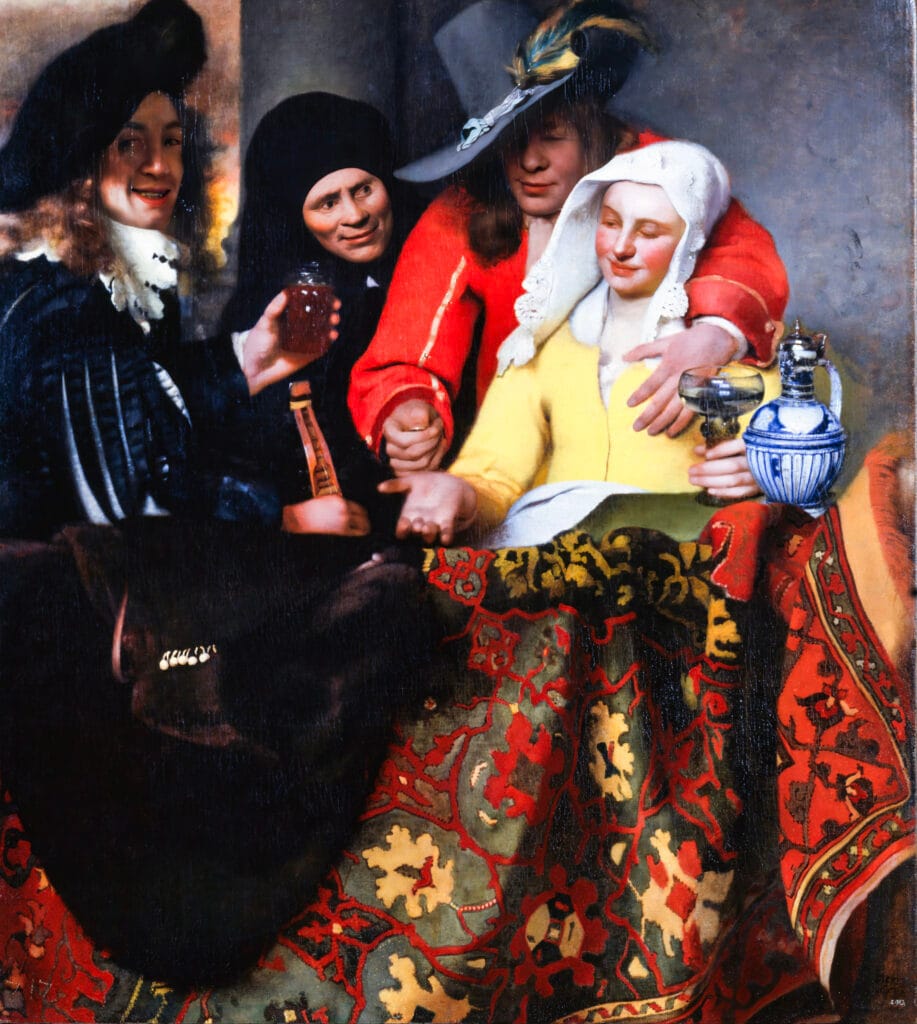
Johannes Vermeer (1632–1675), a Dutch painter from the city of Delft, is widely regarded as one of the most masterful painters of the Dutch Golden Age. Unlike contemporaries who were prolific and traveled widely, Vermeer lived a relatively quiet life, producing a small but exquisite body of work only about 36 paintings survive that has earned him the title ‘The Sphinx of Delft’ due to the mystery surrounding his life and techniques.
Mastery of Light and Atmosphere
Vermeer’s genius lies in his unparalleled ability to capture the subtle effects of light. His paintings are not simply illuminated; they feel as though they are filled with a serene, pearlescent light. He often depicted a single window on the left side of the canvas as the primary light source, creating a soft, diffused glow that gives his interiors a sense of peace and intimacy. This technique, a departure from the dramatic tenebrism of Caravaggio, allows him to meticulously render the textures of objects, the folds of fabric, and the gentle shadows on a person’s face.
Subject and Style
While he began his career with large-scale biblical and mythological scenes, Vermeer is best known for his genre paintings depictions of everyday domestic life. His subjects are often women absorbed in quiet, contemplative activities: reading a letter, playing a musical instrument, or pouring milk. These seemingly simple moments are imbued with a sense of quiet dignity and psychological depth. His paintings are not overtly narrative; instead, they invite the viewer to contemplate a single, suspended moment in time.
Technical Innovations and ‘The Camera Obscura‘
Vermeer’s extraordinary realism and his signature ‘circles of confusion’ small, blurred highlights on shiny surfaces have led many art historians to speculate that he used a camera obscura, a precursor to the modern camera. This device projects an image from an outside scene onto a surface inside a dark room. While he likely did not trace the images directly, the use of such an optical tool would have helped him understand and render the effects of light, perspective, and depth of field with an almost photographic precision.
Notable Works
Vermeer’s small oeuvre includes some of the most beloved paintings in art history:
- Girl with a Pearl Earring: A captivating ‘tronie’ (a study of a face) that, through its striking use of light and the subject’s enigmatic expression, has become one of the most famous paintings in the world.
- The Milkmaid: Celebrated for its remarkable rendering of light and texture, this painting transforms a simple domestic chore into a monument of quiet strength and beauty.
- View of Delft: One of only two surviving landscapes by the artist, this painting is a masterpiece of Dutch Realism, capturing the city’s atmosphere with an incredible sense of scale and detail.
- The Art of Painting: An allegorical work that many consider to be Vermeer’s most significant. It shows a painter at his easel (believed to be Vermeer himself) in the act of creation, a profound statement on the value and importance of art.
Vermeer’s influence has grown immensely since his rediscovery in the 19th century. His meticulous technique, profound sense of stillness, and ability to elevate the mundane to the magnificent continue to captivate audiences worldwide.