
Table of Contents
Overview
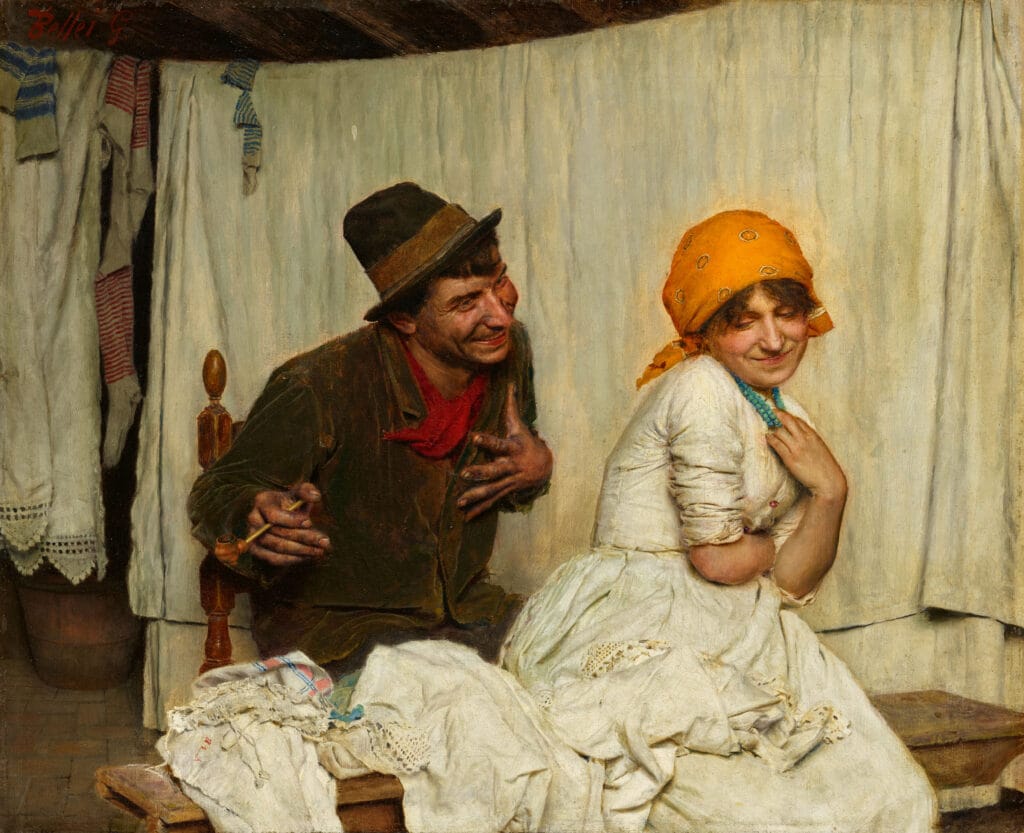
Joy ripples through the small tavern scene in One More for the Road by Gaetano Bellei. Two elderly peasants, seated at a rough wooden table, share laughter and a final toast. The man’s grin and the woman’s shy amusement tell a story of companionship that has outlasted time.
Painted in the late 19th century, the work captures Bellei’s signature blend of realism and affection. Every gesture—his hand reaching across the table, her blushing smile—speaks of warmth, humor, and enduring humanity.
Here, in a room of bare walls and humble light, Bellei turns ordinary life into poetry. The sparkle of shared laughter becomes his truest subject.
Stay a While: One More for the Road
One More for the Road – Gaetano Bellei, c. late 19th–early 20th century
Some moments are too good to end. In One More for the Road, Italian painter Gaetano Bellei gives us a scene not of grandeur or heroism, but of laughter shared across age, across lines, across wine glasses. With a wink and a grin, he captures something timeless: the joy of teasing, the ease of companionship, and the kind of love that wears a few wrinkles.
Bellei, known for his cheerful genre paintings of everyday Italian life, paints not with sentimentality but with affection — and a healthy splash of play.
The Scene Before Us
We find ourselves inside a modest room, sun-bleached and worn, with only a few scraps of paper on the wall and a bare wooden table taking center stage. On one side of it sits a man, hearty and grinning, his hat tipped with a feather and his elbow extended with a glass of wine. On the other side, an older woman leans away with mock protest — her smile giving away the game.
The wine bottle is nearly empty. Dishes are cleared, crumbs remain. But the moment — the real feast — is still unfolding.
They are not rich. They are not young. But they are alive in a way money cannot buy. The table is scratched, the walls faded, yet joy hangs in the air like music after the last note.
The Deeper Meaning
There is humor here, yes — but also tenderness. Bellei’s painting is a toast not only to wine, but to enduring friendship and long-earned connection. These are not strangers flirting. They are likely old companions, maybe husband and wife, maybe just neighbors who’ve known each other too long to be shy.
The man reaches forward not to pressure, but to offer: one more moment, one more laugh, one more sip before we go. The woman’s laughter is not resistance — it’s delight in the ritual, the familiar tug of affection disguised as jest.
There’s a kind of romance here — not of youth, but of comfort. Of knowing each other’s stories by heart and still choosing to sit together. To tease. To share. To stay a little longer.
A Moment Caught in Time
Bellei doesn’t glamorize. He doesn’t soften wrinkles or hide stains. He tells the truth — but gently. And in doing so, he reminds us that aging can carry joy, and humor can be the soul of love.
This isn’t just about wine. It’s about companionship — and how sometimes, a shared glance over a worn table can be richer than any banquet.
Artist
Gaetano Bellei (1857–1922) was an Italian painter from Modena, deeply rooted in the Emilian realist tradition. Trained under Adeodato Malatesta and later influenced by Gaetano Chierici, Bellei became known for his sentimental and theatrical depictions of everyday life.
He specialized in genre scenes—peasants, families, and domestic interiors alive with humor or tenderness. Like Chierici and Giovanni Battista Torriglia, Bellei’s art bridges technical skill and narrative warmth.
Bellei exhibited widely across Italy, earning recognition for paintings that combined meticulous detail with genuine emotion. His works, including The Cherries, Grandfather’s Lesson, and One More for the Road, remain beloved for their authenticity and human spirit.
The Painting Story
A man and woman, likely a long-married couple, sit together at a rustic table. He leans forward, teasingly raising a glass toward her; she, smiling with mock resistance, seems to accept the gesture with playful hesitation.
Between them rests a nearly empty wine flask, the remains of bread and plates pushed aside. The wall behind them is plain, adorned only by faded posters—an honest backdrop for simple lives.
Their clothes tell of rural modesty: his cap with a feather, her headscarf and red kerchief brightening the scene. Bellei invites us to witness not mere comedy, but affection grown from years of shared hardship and joy.
This is not just a tavern—it is a stage where companionship becomes timeless.
Artistic Context
By the late 1800s, Italian art had turned from grand history to the intimacy of realist genre scenes. The industrial age brought new interest in the dignity of ordinary people and the emotional life of the poor.
In Modena and Bologna, painters like Bellei, Chierici, and Zampighi developed a warm, humorous realism that appealed to both local and international audiences. Their paintings echoed the storytelling charm of 17th-century Dutch masters but with a distinctly Italian heart.
One More for the Road reflects that spirit: it is moral, lighthearted, and human, inviting laughter without condescension.
Composition and Subject Matters
Bellei constructs the scene around a triangular composition of hands, faces, and glass—a structure that unites the figures in shared action.
The table forms a horizontal anchor, its surface scattered with subtle textures: glass reflections, linen folds, wooden grain. The man’s arm extends diagonally, guiding the viewer’s eye to the woman’s delighted expression.
The empty walls and dim light emphasize their connection; nothing distracts from their moment. Bellei turns simplicity into intimacy—where laughter, not luxury, fills the space.
Style and Technique
Bellei’s realism is detailed yet soft. He paints flesh tones with warm, earthy hues—ochres, siennas, and gentle rose. The brushwork on clothing is more textured, revealing the fabric’s age and wear.
Light falls from the left, illuminating the man’s grin and the woman’s smile, while the background remains subdued. This subtle contrast enhances the emotional focus of the scene.
Bellei’s technique bridges academic polish and spontaneous life. His controlled realism never feels static; each stroke breathes with motion and warmth.
Symbolism and Meaning
The glass of wine, raised for “one more,” becomes a symbol of companionship and endurance. It’s not excess but celebration—the acknowledgment of simple joys after long toil.
The man’s teasing gesture and the woman’s shy laughter reveal mutual respect and enduring affection. Together they embody the everyday happiness of working people, free from grandeur yet rich in spirit.
Bellei’s message is gentle but profound: happiness is not found in wealth, but in shared moments, laughter, and the comfort of familiar company.
Reflection: One More for the Road – Gaetano Bellei
Between laughter and age,
two hearts share the taste of time.
The wine may fade, the light may dim,
but joy, poured honestly, never runs dry.
In their smile, Bellei paints what endures—
the warmth of love that grows, not fades.
More About Artist
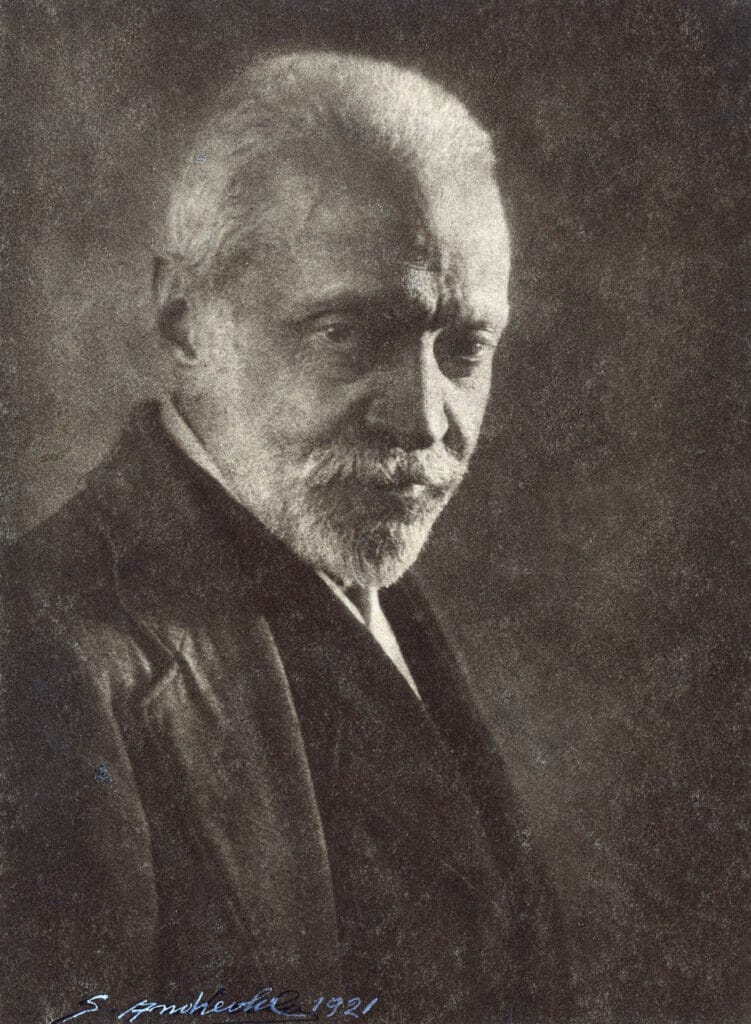
Gaetano Bellei (born January 22, 1857, Modena, Italy – died March 20, 1922, Modena) was an Italian painter best known for his genre scenes, portraits, and religious works. He completed his artistic training at the Academy of Fine Arts in Modena under Adeodato Malatesta and further honed his skills at Rome’s Accademia di San Luca, the French Academy, and the Spanish Academy. Bellei exhibited widely in Italian cities like Turin, Milan, and Rome, as well as internationally in London at the Royal Academy in 1882. He taught at the Academy of Modena from 1893 until his late years.
Artist Style and Movement
Bellei worked primarily within the genre painting tradition, focusing on everyday scenes of rural life and intimate family moments, often featuring elderly people and children. His style blends excellent technical skill with a narrative sensibility that captures human emotions and interactions vividly and tenderly. Though rooted in academic tradition, some of his works showed influence from realism and symbolist tendencies, and he experimented occasionally with Art Nouveau and divisionism techniques. His paintings balance naturalistic detail with a warm, sometimes sentimental portrayal of Italian peasant life.
Artwork Profile / Notable Works
- The Cherries: A classic genre scene depicting a simple, joyful moment centered around sharing or enjoying cherries, embodying Bellei’s gift for capturing warm human interactions.
- The Happy Kitten (“Il micino fortunato”): Exhibited in 1885, this painting brought Bellei commercial success by illustrating a playful, heartwarming scene with a kitten that he reproduced in several variations.
- Resfa: A symbolist-inspired work with darker tones that initially caused controversy but later earned recognition as a significant contribution to modern art in Modena.
- The Port of Livorno: Demonstrates Bellei’s engagement with pointillist and divisionist brush techniques, capturing lively scenes with vibrant details.
- Religious paintings such as the altarpiece of the Redeemer for the parish of Zocca and the Blessed Cottolengo for the Rangoni chapel in Bomporto show his versatility beyond genre painting.
Gaetano Bellei remains an important figure in late 19th and early 20th-century Italian art, renowned for his ability to depict intimate scenes of human emotion with refined technical skill. His genre paintings continue to be appreciated for their narrative warmth and realism, providing a window into everyday Italian rural life and the emotional bonds within families.