

A Glimpse of Quiet Brilliance
In 1801, French artist Marie-Denise Villers painted a young woman caught in a moment of intense focus. She sits in the soft light of a tall studio window, sketchbook in hand, completely absorbed in her drawing. The painting is titled Young Woman Drawing — a simple name for a scene that feels anything but ordinary.
This isn’t just a portrait. It’s a quiet celebration of talent, ambition, and inner life — especially rare for a female artist painting another young woman at work during a time when both were often overlooked.
A Study in Light and Stillness
The young woman wears a pale white gown, loose and simple, with a soft pink sash tied around her waist. Her posture is graceful, but not posed. She leans forward slightly, engaged with the canvas or board before her. Her face, warmly lit by the natural daylight, turns toward us — not surprised, but aware. Her gaze is steady and full of thought.
The room is dim behind her, while outside the large window, Paris is alive. We glimpse another couple strolling in the distance, a subtle hint of the world beyond. But here, in this room, time stands still. The contrast between light and shadow, between interior and exterior, draws our focus to what matters most — her.
A Rare Subject for Its Time
At the dawn of the 19th century, it was still unusual to see women portrayed not as muses or mothers, but as artists. And even rarer still to be painted by a woman. Marie-Denise Villers was part of a small circle of female painters who studied at the Louvre when women were just beginning to enter the art world with their own vision and skill.
The identity of the sitter is still debated — some believe it may be Villers herself, a quiet self-portrait in disguise. Others suggest it is a fellow art student. Regardless, the painting becomes a tribute to every woman who dares to create, to focus, to be serious about her work in a world that often looked away.
An Artist Seen and Remembered
For many years, Young Woman Drawing was wrongly attributed to Jacques-Louis David, one of the most famous male artists of the time. Only later was it recognized as Villers’ own work — a reminder of how easily women’s names were left out of history.
But now, the young woman at the window looks back at us clearly. Her pencil hovers, her eyes meet ours, and her presence speaks louder than ever. This is not just a moment of learning or study. It’s a portrait of purpose — of a woman, in her own light, doing what she was meant to do.
About Artist
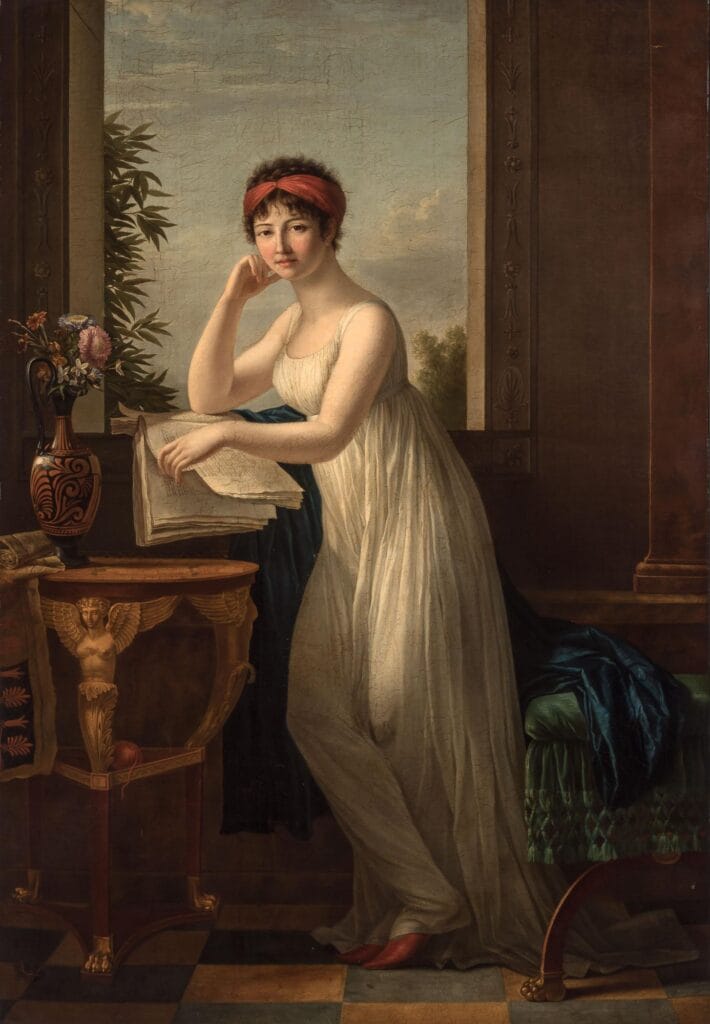
Marie-Denise Villers (née Lemoine) was born in 1774 in Paris, France, and died on August 19, 1821, also in Paris. She came from an artistic family; two of her older sisters and a cousin were also portrait painters. Villers studied under prominent Neoclassical painters, notably Anne-Louis Girodet-Trioson, François Gérard, and Jacques-Louis David. She exhibited her first works at the Paris Salon in 1799.
In 1794, she married Michel-Jean-Maximilien Villers, an architecture student who supported her artistic career—unusual for women artists at the time who often ceased professional work after marriage. Despite a productive early life, her activities and works after 1814 are largely undocumented. She specialized in portraiture and was recognized for the softness and luminescence in her color palette.
Artistic Style
Marie-Denise Villers’s style reflects French Neoclassicism, characterized by clarity, refined detail, and balanced composition. She focused on the delicate rendering of her subjects, often women, capturing their personality and mood with subtlety. Her use of light creates a soft, glowing ambience, and her brushwork is finely detailed, especially in textiles and facial expression. Her portraits blend realism with an idealized gracefulness, embodying a gentle yet dignified presence.
Notable Artworks
- Young Woman Drawing (Portrait of Charlotte du Val d’Ognes) (1801): Villers’s most famous work, housed in the Metropolitan Museum of Art in New York, was long misattributed to Jacques-Louis David. The painting shows a young woman, often identified as Charlotte du Val d’Ognes, depicted seated with a drawing pad, looking over her shoulder towards the viewer. The composition includes a broken windowpane framing a distant couple, adding narrative ambiguity and emotional depth. Art historians now recognize this as a likely self-portrait or at least a deeply personal portrayal of an independent young woman artist.
- Une Étude de Femme d’après Nature (Study of a Woman from Nature) (1802): This portrait exemplifies Villers’s talent in capturing realistic female subjects with transparency and poise, now in the Louvre.
- A Child in Its Cradle, Driven by Flood Waters (1802; later replica in 1810): A genre painting depicting vulnerability and nature’s power, showing versatility beyond portraiture.
Marie-Denise Villers stands out as a talented female artist of the Neoclassical period who achieved recognition for her sensitive portraits in a male-dominated field. Her legacy is highlighted by the rediscovery and rightful attribution of “Young Woman Drawing,” which remains a celebrated example of early 19th-century portraiture reflecting women’s artistic presence.