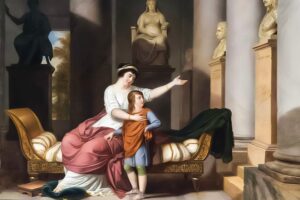

Alcibiades being taught by Socrates
François André Vincent, 1776
A Lesson in Glory and Restraint
In this radiant painting by François-André Vincent, we step into a quiet, intense moment between two unforgettable figures of ancient Greece: Socrates, the philosopher with a rugged face and a firm mind, and Alcibiades, the young, golden-haired warrior wrapped in armor and ambition. It is a meeting not of weapons, but of words—an exchange that shaped the path of history.
A Contrast of Strengths
On the left stands Alcibiades, resplendent in shining armor, crowned with a brilliant helmet, and wrapped in a flowing purple cloak. His body speaks of youth, beauty, and battle-readiness, but his eyes reveal something else—attention, curiosity, and perhaps confusion. He was not just a soldier but also a statesman, beloved by Athens, feared by enemies, and haunted by scandal. At this moment, though, he is simply a student.
The Voice of Reason
Facing him, seated and grounded, is Socrates. Clothed in calm earth tones and a blue drape, he raises his hand not in command but in gentle persuasion. His finger points upward, as if guiding Alcibiades beyond the visible world—toward truth, virtue, and self-mastery. His expression is steady, full of conviction. He does not flatter. He challenges.
The Silent Witness
Behind Socrates, an angelic youth watches closely, perhaps a symbol of inner conscience or philosophical spirit. A laurel crown circles his golden hair, suggesting victory—not on the battlefield, but in the realm of thought. He represents the nobler ideal Socrates urges Alcibiades to seek: not the praise of men, but the triumph of the soul.
Between Two Paths
The scene captures a moment of choice. Alcibiades, like many young people, stands at a crossroads between glory and wisdom, impulse and reflection. Socrates does not promise power or applause. He offers something deeper—clarity, discipline, and the courage to question oneself. Whether Alcibiades listens or strays, we do not yet know. That is the quiet power of this painting.
The Eternal Conversation
Vincent’s work is more than a portrait of two historical figures. It is a timeless image of the teacher and the student, the old and the young, the thinker and the doer. It reminds us that true greatness is not in armor or beauty, but in the ability to listen, reflect, and change. And in this gentle moment, frozen in light and shadow, we are invited to witness that very transformation begin.
About Artist
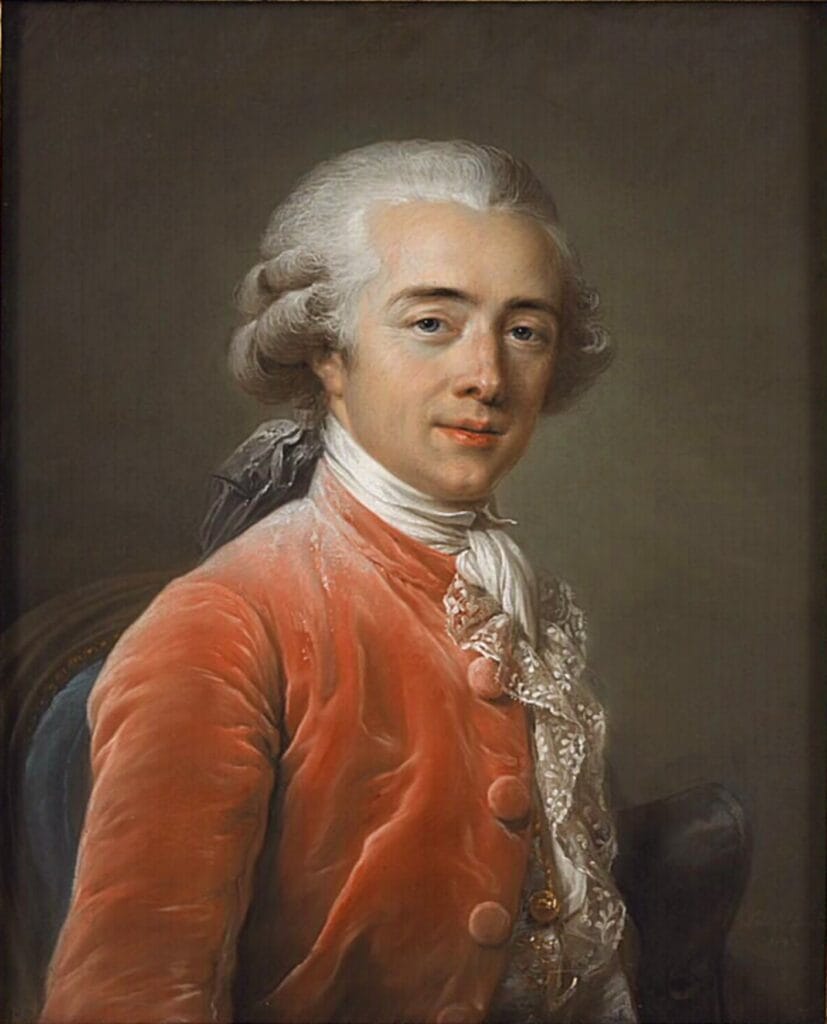
François-André Vincent (1746–1816) was a prominent French painter who, along with his contemporary Jacques-Louis David, was a leading figure of the Neoclassical movement. The two artists were fierce rivals in their youth, both championing a return to the moral and aesthetic values of antiquity. Vincent’s style, however, tended to be more focused on graceful compositions and luminous color than the severe political messages of David, making his work a sophisticated blend of classical ideals and elegant execution.
Artistic Style and Career
Vincent’s training took him to Italy, where he studied under Jean-Honoré Fragonard, and he was later influenced by classical art and the works of Rubens. His style is characterized by:
- Refined Classicism: He employed a clean, linear style with a focus on clear compositions and well-defined forms.
- Lively Color: Unlike the often somber palette of some Neoclassicists, Vincent used a more vibrant and expressive range of colors.
- Historical and Allegorical Subjects: He often drew inspiration from ancient history and mythology to create works that conveyed moral or allegorical messages.
Vincent was a highly respected teacher at the French Academy, and his influence helped shape the next generation of French painters.
Notable Works
- Alcibiades Being Taught by Socrates (1776): This painting is a clear expression of Neoclassical ideals. It depicts the young Athenian general Alcibiades receiving wisdom from the philosopher Socrates. The work’s focus on moral instruction and the dignity of classical figures is a hallmark of Vincent’s style.
- The Earl of La Forest (c. 1779): A magnificent example of his portraiture, this work is not just a likeness but a study in character. It is celebrated for its meticulous detail, particularly in the clothing and textures, and the sitter’s calm, dignified expression.
- The Battle of the Redoubt of Saint-Gervais (1788): A large-scale history painting, this work depicts a scene from a real event. It showcases Vincent’s skill at dynamic composition and his ability to combine historical accuracy with dramatic flair.
- L’Agriculture (c. 1798): This painting is an allegorical scene that idealizes the virtues of rural life and hard work. It reflects the shift in social values during the late 18th century, which often romanticized nature and labor.