
Table of Contents
Gustav Klimt: The King of Vienna
Vienna Secession
At the end of the nineteenth century, Vienna stood at the intersection of tradition and modernity, and Gustav Klimt stood at its center. As the first president of the Vienna Secession, he helped lead artists away from rigid academic standards toward a new visual language shaped by symbolism, decoration, and psychological depth.
The break was more than stylistic. It challenged cultural authority itself.
Art no longer needed approval from institutions to exist.
Klimt became the visible face of this transformation. Patrons followed the movement, and wealthy clients sought portraits that reflected modern taste, intimacy, and refinement. His gold-ornamented works soon defined the visual identity of the city’s artistic elite.
Controversial
Influence did not protect him from conflict. If anything, it intensified it.
Klimt’s paintings for the University of Vienna triggered fierce public debate. Officials and critics condemned the works as inappropriate for academic spaces, accusing them of moral ambiguity and excessive sensuality. Newspapers amplified the dispute, turning artistic disagreement into a national scandal.
The episode shaped his reputation permanently.
Admired by collectors, distrusted by institutions, Klimt emerged as an artist whose authority rested on independence rather than approval.
The Kiss: Symbol of Eternal Love
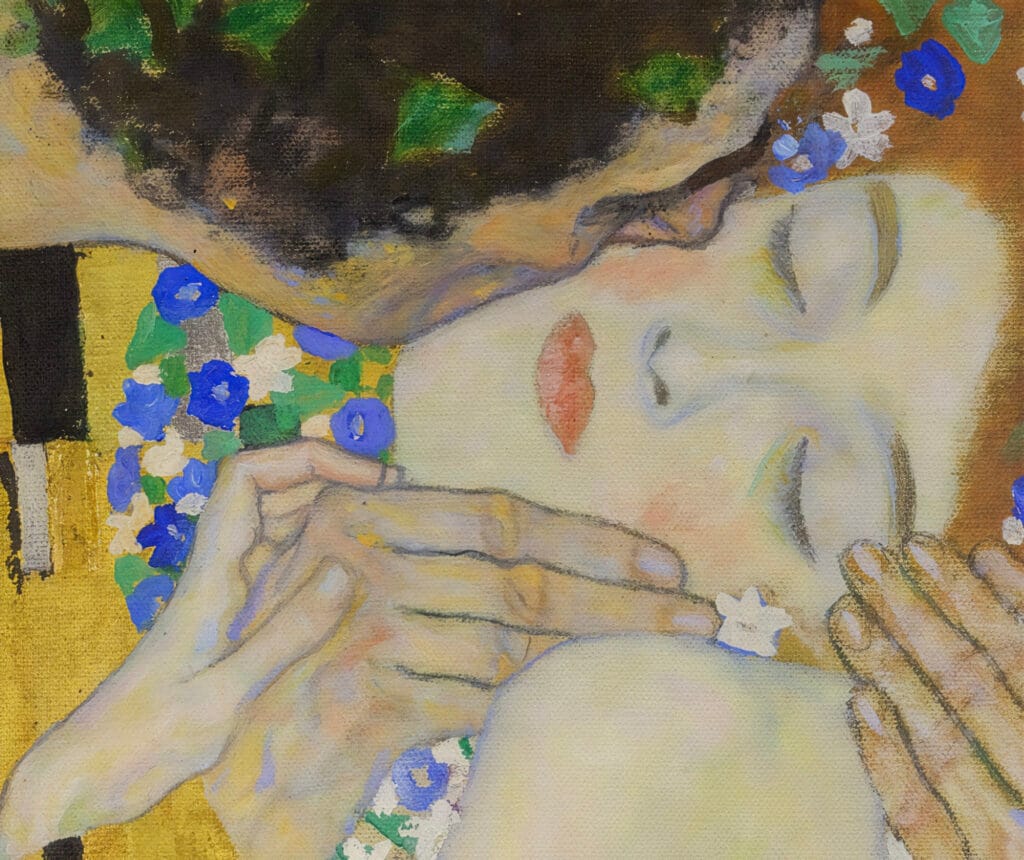
At the height of this tension came The Kiss, now the most recognizable image of Klimt’s career and the culmination of his Golden Phase.
A couple merges into pattern and light. Bodies dissolve beneath ornament, suspended between reality and symbol. Sheets of gold leaf transform a private embrace into something almost sacred, a moment removed from ordinary time.
The painting offered what controversy could not erase, a vision of intimacy elevated into permanence.
The Kiss meaning: by Venwick editors
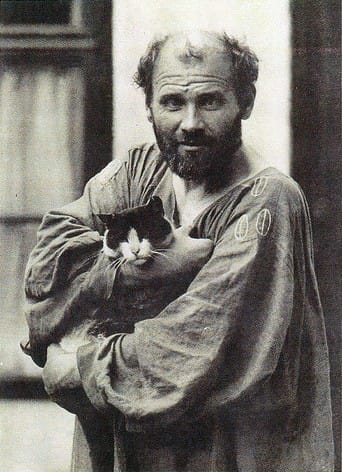
Gustav Klimt and Cats
Visitors entering Klimt’s studio often expected grandeur. Many left remembering something far simpler.
Cats were everywhere.
They moved between canvases and sketches, settled among fabrics, and wandered through a workspace that felt closer to a lived apartment than a formal atelier. Klimt was a lifelong animal lover, and his connection with them appeared effortless.
To be fair, it was often less about Klimt than about the cats themselves. Once these creatures enter a life, they quietly reshape it. They rule the space, and sometimes the inner world of their companion. Ownership becomes uncertain. Who own whom. We like to believe we keep them, yet anyone familiar with cats knows the balance is reversed.
Klimt welcomed their disorder. He never seemed annoyed, as if their presence carried a value beyond the careful perfection of the golden works surrounding him, a living interruption accepted as part of the studio’s rhythm.
Artists and Unusual Materials
The Search for the Perfect Color
Long before modern chemistry standardized artistic supplies, painters searched obsessively for materials that could produce deeper color, stronger adhesion, or longer permanence. The pursuit of beauty often outweighed comfort, safety, or ethics.
Across the centuries, studios have become places of experimentation. Artists ground minerals, boiled organic matter, and tested substances whose dangers were poorly understood. What mattered was visual effect, luminosity, transparency, and intensity. The result was a history filled with materials that today feel unsettling, even improbable.
Strangeness, in art, is rarely accidental. It is usually practical.
Mummy Brown and Indian Yellow
Some of the most admired pigments carried unexpected origins.
Mummy Brown, valued for its warm transparency, was produced from ground ancient Egyptian remains traded through European markets. Indian Yellow, celebrated for its glowing golden tone, was derived from the processed urine of cows fed restricted diets.
Both pigments offered qualities artists struggled to replicate. Both eventually disappeared, abandoned as ethical concerns and modern alternatives emerged.
Beauty often arrived with a hidden cost.
Poison in the Palette
Not all risks were symbolic. Many were lethal.
Highly toxic, Scheele’s Green contained arsenic and released toxic vapors under certain conditions. Lead White, one of the most widely used pigments in Western painting, slowly poisoned generations of artists through prolonged exposure. Yet painters continued to rely on them because no substitute matched their brilliance or handling qualities.
Durability and luminosity outweighed danger for centuries.
Fixatives, Sealants, and Experiments
Beyond pigments, artists constantly searched for ways to stabilize drawings and surfaces. Isinglass, derived from fish bladders, served as a transparent adhesive and fixative. Skimmed milk solutions appeared in studio recipes as temporary sealants.
Materials moved freely between kitchen, workshop, and studio. Boundaries between craft and daily life were thin, and experimentation was expected rather than exceptional.
Within this context, unusual solutions did not automatically seem irrational.
Bodies as Material
In modern art, experimentation extended even further. Some contemporary artists began using biological substances directly as artistic media. Marc Quinn’s self-portraits, cast from his own frozen blood, transformed the body itself into material, collapsing the distance between creator and artwork.
The gesture shocked audiences, yet followed a long tradition of artists testing the limits of what art could physically contain.
Colors Born From Animals
Even some of history’s most prestigious colors depended on living sources. Cochineal red came from crushed insects, producing a vibrant pigment once reserved for power and ceremony. Tyrian Purple required thousands of sea snails to yield small amounts of dye, making it among the most valuable colors of the ancient world.
What appears strange today was once simply technique.
And seen against this history, the idea that artists experimented with unexpected materials begins to feel less like fantasy and more like possibility.
And the list goes on. In the ancient world, unusual organic materials were used not only as pigments but for other critical purposes such as medicine.
The Urine Rumor
A Studio Story
Somewhere between documented memory and later retelling, a peculiar claim began to circulate. Gustav Klimt, it was said, allowed his cats to urinate freely in the studio and believed the liquid helped preserve pencil drawings. In certain versions, a playful remark was attributed to him, suggesting the animals caused trouble only for others.
No contemporary record from Klimt’s lifetime confirms the claim.
The detail was vivid enough to survive repetition.
It sounded personal. Specific. Almost eyewitness.
And that made it easy to believe.
Why It Felt Possible?
By the time the story gained traction, Klimt already carried the image of an unconventional artist. The robe, the secluded working habits, the studio filled with animals, all reinforced a portrait of eccentric independence.
Placed beside a long history of unusual artistic materials, the rumor did not appear impossible. Artists had experimented with stranger substances. Audiences simply connected familiar fragments into a single explanation.
The myth did not arrive from nowhere.
It grew naturally from context.
First Speculation
Some historians approach the story cautiously rather than dismissing it outright. Klimt allowed cats to move freely through the studio, and it is reasonable to assume traces of animal presence existed. If urine ever touched artworks, they argue, it may have happened accidentally rather than intentionally.
Yet practical details complicate this idea.
Paintings and drawings were typically kept upright, hung, or leaning vertically against walls. The anatomy and behavior of cats make such contact unlikely. Cats do not spray randomly in calm domestic environments, and their habits tend toward specific, repeated locations rather than open surfaces.
The scenario becomes difficult to sustain once everyday reality enters the picture.
Second Speculation
A more skeptical view rejects the story entirely. Collecting cat urine at scale is impractical. Even if the intention exists, the idea of systematic farming of this substance is nearly impossible.
Third Speculation
A studio filled with animals carries a distinct smell. Odor settles into fabrics, wood, and paper over time. Visitors may have remembered the environment strongly enough that later retellings transformed scent into substance, presence into technique.
The Power of Repetition
Once repeated often enough, anecdote begins to resemble history. Each retelling removes hesitation. Uncertainty fades. A possibility slowly becomes accepted memory.
The rumor persists because it offers a vivid explanation, replacing slow and ordinary aging with a single unforgettable image.
And stories that are easy to picture are rarely easy to erase.
Does it Matter?
In the end, the question may matter less than the reason it continues to be asked.
- Klimt’s attachment to cats was real.
- The animals were real.
- The atmosphere visitors remembered was real enough to linger long after they left.
Somewhere between observation and retelling, a detail expanded, shaped by imagination and repetition until it became inseparable from the artist himself.
No evidence confirms a deliberate method. No document settles the story completely. What survives instead is a reminder of how easily personality forms around great figures, especially when fragments of truth already exist.
Art history often moves this way. A smell becomes a material. A habit becomes a technique. A memory becomes an explanation.
Klimt’s drawings endure not because of unusual substances, but because of attention, patience, and observation. The myths arrived later for many reasons, attaching themselves quietly to the work.