
Table of Contents
A Playful Pursuit: Fragonard’s ‘Blind Man’s Buff’
By Jean-Honoré Fragonard, around 1750
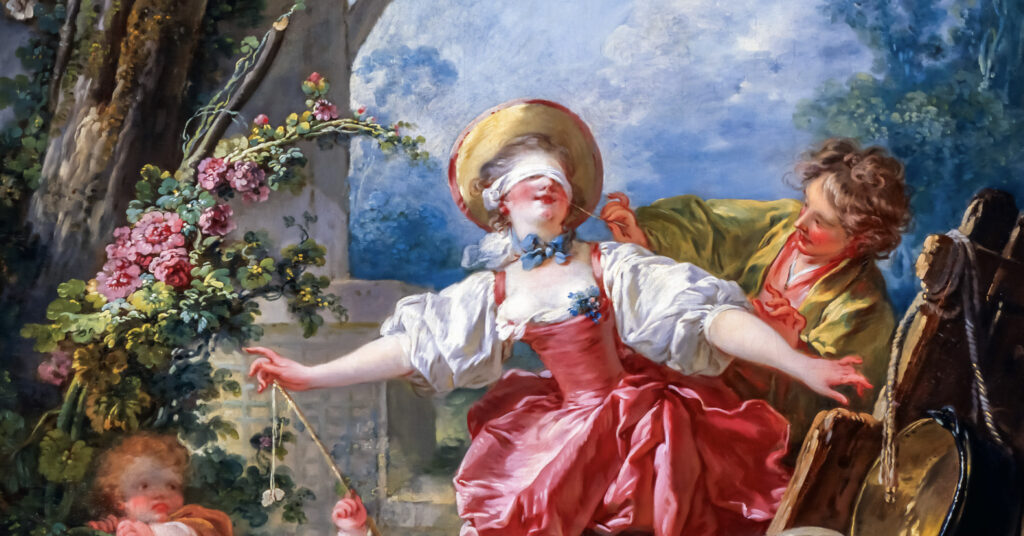
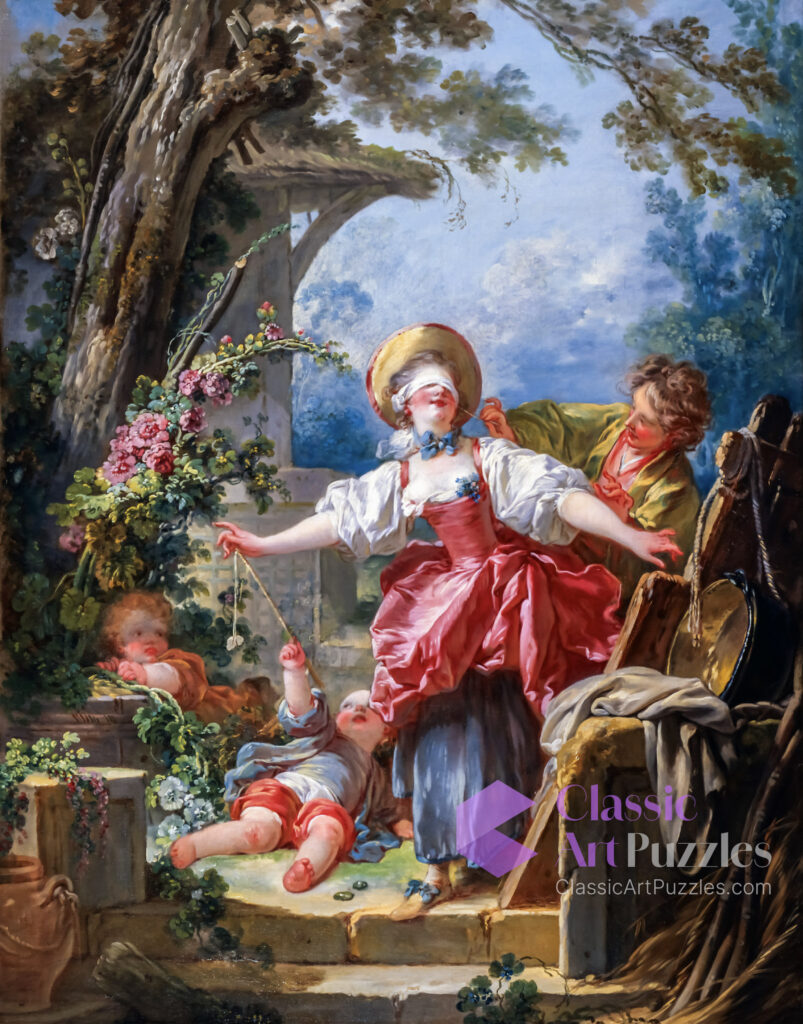
Imagine a sunny afternoon outdoors, filled with laughter, teasing, and the happy chaos of a favorite game. That’s exactly what Jean-Honoré Fragonard brings to life in his painting Blind Man’s Buff. Created around 1750, this charming artwork perfectly captures the Rococo style, known for its playful elegance, romantic themes, and scenes full of joy.
A Lively Game in a Garden
In this delightful painting, we join a young woman playing the classic game of “blind man’s buff,” where one person wears a blindfold and tries to catch their friends. But in Fragonard’s hands, it’s more than a simple game. It becomes a joyful symbol of love and flirtation.
Meet the Main Characters
- The Blindfolded Lady: At the center is a graceful young woman, elegantly dressed in soft pink, blue, and white fabrics. Her eyes are covered with a white blindfold, topped by a stylish straw hat. Her arms are stretched out, carefully feeling her way forward, totally caught up in the excitement.
- The Playful Young Man: Right behind her stands a young man dressed in earthy colors. His face lights up with a mischievous smile as he gently teases or guides her, clearly enjoying this playful moment.
- Charming Putti: Adding magic and symbolic sweetness to the scene are two delightful little putti, cherub-like figures often representing love and innocence. One putto lies on the ground, happily reaching out towards the dangling cord. The other peeks out shyly from behind greenery. Their playful presence reminds us that this moment is about love, joy, and the sweet innocence of playful romance.
The Enchanting Garden
Fragonard places the scene in a beautiful, lush garden full of life and delicate details:
- Blossoms and Greenery: The background bursts with lush greenery and vibrant pink roses. A large tree with twisting branches provides cool shade and natural beauty, framing the playful scene perfectly.
- Romantic Architecture: Behind the figures, we catch a glimpse of elegant garden architecture, perhaps a charming trellis or a hidden gazebo, adding depth and elegance.
- Rustic Details and Music: On the right, rustic elements—like woven baskets, leaning boards, and a tambourine, suggest music, festivities, and a day filled with leisurely fun.
More Than a Game
Fragonard’s painting isn’t simply about people playing outdoors. It’s also about the gentle dance of romance. The blindfold symbolizes how love is often playful, unexpected, and surprising. Through the smiling faces and charming putti, the artist invites us to share this moment of carefree joy, reminding us that sometimes the sweetest connections happen when we least expect them.
This enchanting scene captures the heart of Rococo charm, celebrating youthfulness, romance, and the delight found in life’s playful moments.
Key Facts
- Artist: Jean-Honoré Fragonard
- Title: Blind-Man’s Buff
- Date: c. 1750
- Medium: Oil on canvas
- Style: Rococo
- Subject: Blindfolded game of blind-man’s buff
- Dimensions: approx. 91 × 72 cm (dimensions vary slightly by source)
- Current Location: National Gallery of Art, Washington, D.C.
Artist
Jean-Honoré Fragonard was one of the most celebrated painters of mid-eighteenth-century France. Trained in Paris and shaped by time spent in Italy, he developed a style defined by speed, fluid brushwork, and an instinctive sense of pleasure. Fragonard worked comfortably across genres, history painting, mythological scenes, portraits, and intimate genre subjects.
By around 1750, when Blind-Man’s Buff was painted, Fragonard was still early in his career but already displaying the qualities that would define his work. Lightness, movement, and emotional immediacy take precedence over moral instruction or narrative gravity. Painting, for Fragonard, is a vehicle for sensation.
Style and Technique
The painting exemplifies Rococo aesthetics at their height. Color is fresh and luminous, dominated by soft pinks, blues, and greens. Brushwork is loose and animated, often visible, creating a sense of motion even in still forms. Light moves freely across surfaces, binding figures and setting into a single atmospheric space.
Edges dissolve rather than harden. Fabrics shimmer rather than weigh down the figures. This technical looseness is deliberate. It supports the painting’s subject, a fleeting moment of play, rather than a fixed or monumental scene.
Fragonard’s technique in this early work shows his transition from the influence of his teacher, François Boucher, toward his own more fluid, energetic style.
Color Palette: Dominated by soft pastels, earthy terracottas, and ‘Fragonard gold,’ creating a warm, hazy atmosphere. Brushwork: While more controlled than his later ‘fantasy figures,’ the foliage shows the rapid, “feathery” strokes that would become his signature.
Subject Matter
Blind-Man’s Buff depicts a popular game in which one participant is blindfolded and attempts to catch the others by touch alone. Here, a young woman stands at the center, eyes covered, arms extended, reaching uncertainly into space. Around her, children and young figures move just beyond her grasp, laughing, crouching, and retreating.
The scene unfolds in a garden setting, suggesting leisure rather than discipline. No authority figure intervenes. The game is voluntary, social, and gently chaotic. It is not about winning, but about movement, anticipation, and shared amusement.
Composition
Fragonard organizes the composition around the blindfolded figure, whose open arms create a wide arc that pulls the eye across the canvas. Surrounding figures respond to her movement, forming a loose circle of avoidance and attraction.
The setting contributes actively to the scene. Trees, architectural fragments, and foliage frame the action without enclosing it. The ground tilts slightly forward, bringing the figures closer to the viewer and enhancing immediacy. Nothing in the composition feels static. Balance is achieved through motion rather than symmetry.
Historicy and Context
In eighteenth-century France, games such as blind-man’s buff were common in both rural and aristocratic settings. They symbolized leisure, sociability, and controlled disorder. Within Rococo culture, play was not trivial. It was an expression of refinement and ease, a sign that one had time and space for pleasure.
Paintings of games and amusements were especially popular among private patrons. They reflected ideals of grace, spontaneity, and youthful energy. Fragonard’s treatment avoids moralizing. The game is not a lesson. It is an experience.
Commentaries and Discussion
Play, Uncertainty, and Trust
At the heart of the painting is a paradox. The blindfolded figure is momentarily vulnerable, deprived of sight and control, yet the scene remains safe. The others tease her, but they do not abandon her. The game depends on trust as much as misdirection.
This balance reflects a broader Rococo sensibility. Pleasure is heightened by risk, but the risk remains contained. Fragonard captures the instant where uncertainty feels exhilarating rather than threatening.
Art historians frequently discuss this painting not just as a depiction of a pastime, but as an allegory for courtship. In Rococo art, games were rarely just games; they were metaphors for the unpredictability of romance.
Innocence and Suggestion
While the subject appears playful and childlike, Fragonard leaves room for ambiguity. The reaching hands, the laughter just out of reach, and the closeness of bodies introduce a gentle undercurrent of desire. This duality is characteristic of Rococo art, where innocence and suggestion often coexist.
Importantly, the painting does not push the scene toward overt meaning. Suggestion remains suggestion. The mood stays light.
Movement as Meaning
More than narrative or symbolism, movement carries the painting’s meaning. The blindfolded woman’s uncertainty, the children’s quick steps, the rustling foliage, all contribute to a sense of life unfolding in real time. The painting feels less like a frozen image and more like a moment briefly paused.
Fragonard’s skill lies in allowing that pause without killing the motion. The viewer senses that the game will resume the instant the eye looks away.
Rococo Without Apology
Blind-Man’s Buff stands as an unapologetic celebration of Rococo values. Pleasure is not justified by morality. Play does not need a lesson. Beauty is sufficient on its own terms.
In this way, the painting resists later judgments that dismissed Rococo as frivolous. Fragonard shows that lightness can be deliberate, and that joy, when observed closely, is a serious subject in itself.
More About Artist
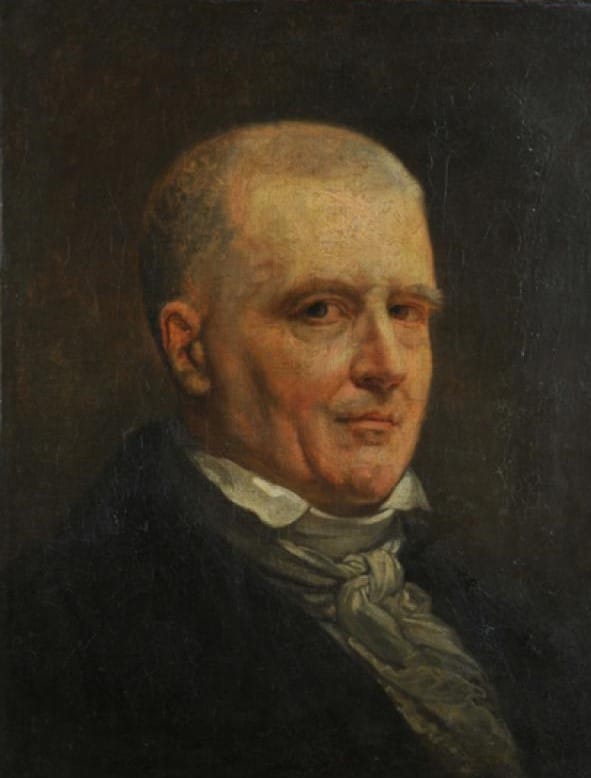
Jean-Honoré Fragonard (1732–1806) was a French painter and printmaker who is considered one of the leading figures of the Rococo art movement. His style is a vibrant and fluid expression of the late Rococo, known for its lightheartedness, sensuality, and free-flowing brushwork. Unlike his contemporary Boucher, whose work could sometimes feel more formal, Fragonard’s paintings have a spontaneous and energetic quality that perfectly captured the spirit of the French aristocracy on the eve of the revolution.
Artistic Style and Legacy
Fragonard was a student of François Boucher, and he inherited his master’s love for mythological and pastoral themes. However, Fragonard’s style is more dynamic and painterly, with a liveliness all his own. His work is characterized by:
- Energetic Brushwork: His brushstrokes are visible and expressive, creating a sense of movement and spontaneity.
- Lush, Luminous Color: He used a rich and glowing palette, with shimmering whites, rose, and gold.
- Playful Sensuality: He often depicted scenes of romantic trysts, playful games, and idyllic moments of love, with a light and often erotic touch.
Fragonard’s art fell out of fashion during the Neoclassical period, which favored more serious, moralizing subjects. He died in obscurity, but his reputation was revived in the 19th century, and he is now celebrated as a master of the Rococo.
Artwork Profile
Here are paintings by Jean-Honoré Fragonard. They are excellent examples of his style and a testament to his genius.
- The Swing (c. 1767): This is arguably Fragonard’s most famous painting and a quintessential work of the Rococo period. It depicts a young woman on a swing, with her suitor hiding in the bushes below, catching a glimpse of her as she kicks off her shoe. The lush, overgrown garden, the playful sensuality, and the charming narrative make it an icon of the era.
- The Lover Crowned (c. 1771-1772): Part of a famous series known as “The Progress of Love,” this painting shows a young woman crowning her lover with a wreath of flowers. The scene is filled with a sense of joyous, unrestrained romance.
- The Musical Contest (c. 1754): An early work from his Italian period, it shows a group of young people engaged in a musical game, demonstrating his early interest in playful social scenes.
- The Shepherdess (c. 1760): A charming example of his pastoral scenes, it depicts an idealized country girl in a beautiful, natural setting.
- Blind Man’s Buff (c. 1750-1752): Fragonard painted a few versions of this popular game. The one in the National Gallery of Art is a lively, outdoor scene full of energy and flirtation.
- The Happy Lovers (c. 1765): A beautiful and tender portrayal of a young couple, it perfectly captures the idealized, amorous mood of his mature style.